Sound and stone are the two gentlest tools in crystal practice, and they are better together. Sound cleansing — a singing bowl, a bell, a chime, or your own voice humming — asks nothing of a stone’s hardness or chemistry, so it suits every bracelet you own. Adding the stones back in gives the sound somewhere to land: in chakra tradition, each center is associated both with a crystal and, in many lineages, with a seed sound or tone, so a session can move up the body pairing tone with stone, center by center. The result is a ten-minute reset that is part meditation, part bracelet care.
This guide shows how to run a combined session for a full set of chakra jewellery, how to pair sounds with each center, and how to adapt it with nothing more than a phone and a bell app if no bowl exists yet. Our standalone guide to cleansing crystals with sound covers the sound-only method in depth.
Pairing Tones and Stones, Root to Crown
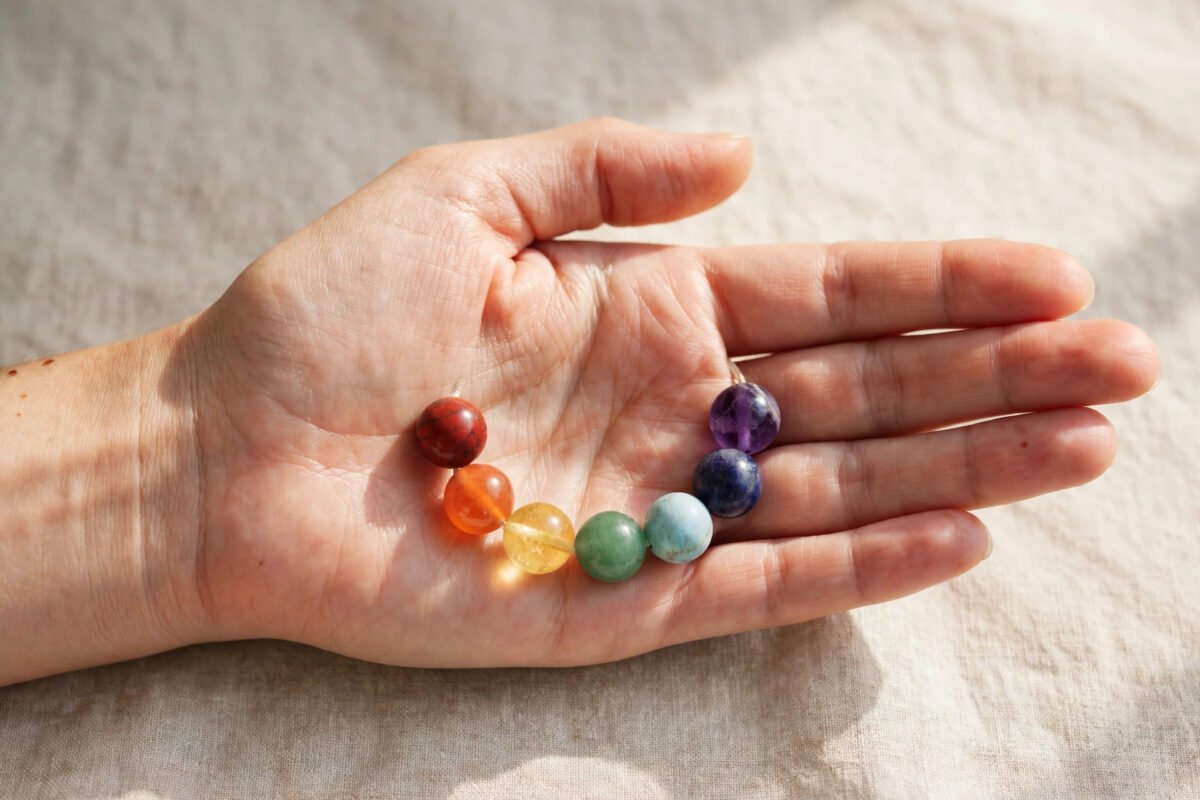
Traditional pairings vary by lineage, but a widely used set runs: root with a deep bowl tone or the seed sound LAM, paired with red jasper or hematite; sacral with VAM and carnelian; solar plexus with RAM and citrine or tiger’s eye; heart with YAM and rose quartz or green aventurine; throat with HAM and aquamarine or sodalite; third eye with OM and amethyst; crown with silence after OM, and clear quartz or selenite. Our grounding stones guide, heart chakra stones guide, and crown chakra stones guide detail each center’s crystals.
You do not need seven different bowls. One bowl, struck or circled at different moments, covers the session; the changing element is the stone in your hand and the intention at each step. Chanting the seed sounds quietly is the oldest version of this practice and costs nothing. If chanting feels self-conscious, hum — the throat center’s work begins the moment you let yourself be heard, even by a room of one. Historical background on singing bowls is collected in the Wikipedia article on singing bowls.
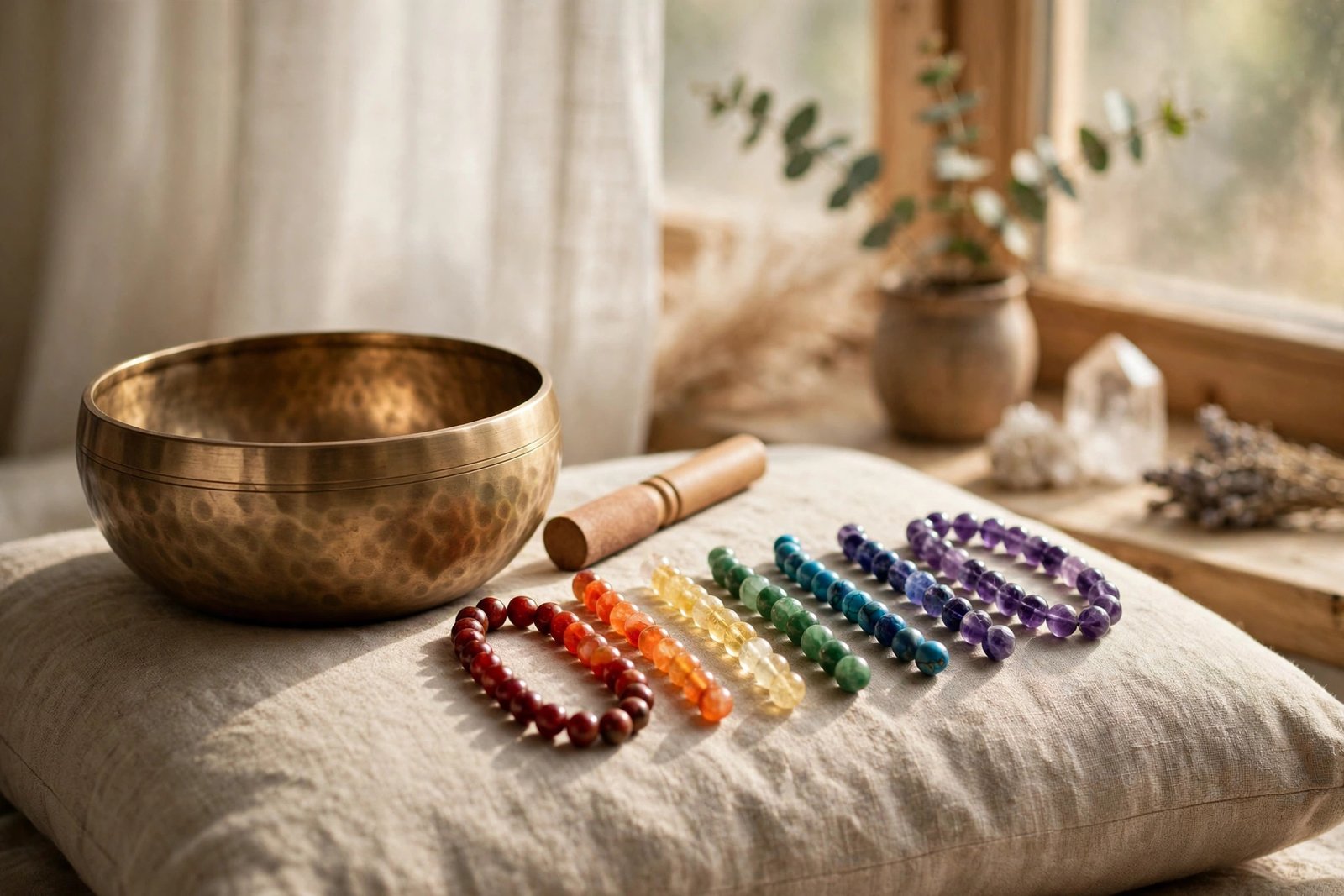
Lay your pieces out in order before you begin: bracelets in a row, root to crown, on a cloth. An AVENSU seven-chakra bracelet can stay coiled as the set’s anchor, with single-stone pieces — like the Vòng tay tình yêu bằng thạch anh hồng — placed at their centers. Browse the Cửa hàng AVENSU if your row has gaps.
A Ten-Minute Combined Session
Minute one: settle. Sit with the stones in front of you, strike the bowl once, and breathe until the sound fully fades. Minutes two to eight: work upward. For each center, hold or touch its stone, sound the bowl or chant its seed syllable three times, and breathe slowly between tones. Our guide to chakra affirmations and crystals can replace chanting here — speak each center’s mantra once per tone if words suit you better than syllables.
Minutes nine and ten: integrate. Place the full set in a small pile or line, sound the bowl one final time, and let your hands rest. In tradition, this closing tone is believed to settle the whole column at once. Then put the jewellery on, or return it to its pouch, while the room still feels quiet. The practice pairs naturally with a crystal meditation for beginners on days you have twenty minutes instead of ten.
An AVENSU bracelet cleansed this way weekly tends to stay in the rotation longer, simply because the care ritual is pleasant rather than a chore. Compare methods honestly: salt water, covered in our salt water cleansing guide, suits hard stones only, while sound suits everything, including selenite and metal-accented pieces.
Practical Tips and Troubleshooting
Volume: softer than you think. A bowl played gently beside bracelets on a cloth sounds clear without startling anyone; hard striking on a hard surface makes stones jump and chips possible. Keep the bowl on a cushion, the stones on fabric, and at least a hand’s width between them.
Shared homes: a bell or a phone’s bowl recording at low volume achieves the same ritual shape. Headphones break the “room” feeling but work for personal meditation with a stone in hand. Roommates and thin walls are real constraints; a tradition that cannot survive an apartment is not much of a tradition.
If a session feels flat, change one variable only — a different center order, a slower pace, or stones worn instead of lined up, as in our chakra crystal body layout guide. Flat usually means rushed. Give the fading of each tone its full time; the silence between sounds is where this practice actually happens. For the acoustics and cultural history of bowls and bells, Britannica maintains accessible reference entries on both instruments.
Các câu hỏi thường gặp
Do I need a singing bowl to cleanse with sound?
No. A bell, a chime, tuning fork, clapping, chanting, or a good bowl recording all follow the same principle. The voice is the traditional instrument and the one you always have with you. Choose the sound you find genuinely pleasant, because you will use it weekly.
Is sound cleansing safe for all crystals?
Yes. Sound touches nothing and soaks nothing, so it is the safest method for soft, porous, or metal-accented stones such as selenite, malachite, and bracelets with charms. It is the recommended default for mixed seven-chakra pieces whose stones have different care needs.
How often should I do a combined sound and stone session?
Weekly suits most wearers, often as a Sunday reset before the week begins. After travel, illness in the house, or a stretch of heavy days, an extra session is a kind, low-effort reset. Daily full sessions are unnecessary; a single bell tone in the morning covers ordinary days.
Should the stones be worn or laid out during sound cleansing?
Either works. Laid out in chakra order suits a full set cleanse and makes the root-to-crown sequence easy to follow. Worn suits a personal meditation, where the sound is for you and the cleansing is secondary. Many people lay pieces out for the session, then wear them straight afterwards.








 English
 Vietnamese