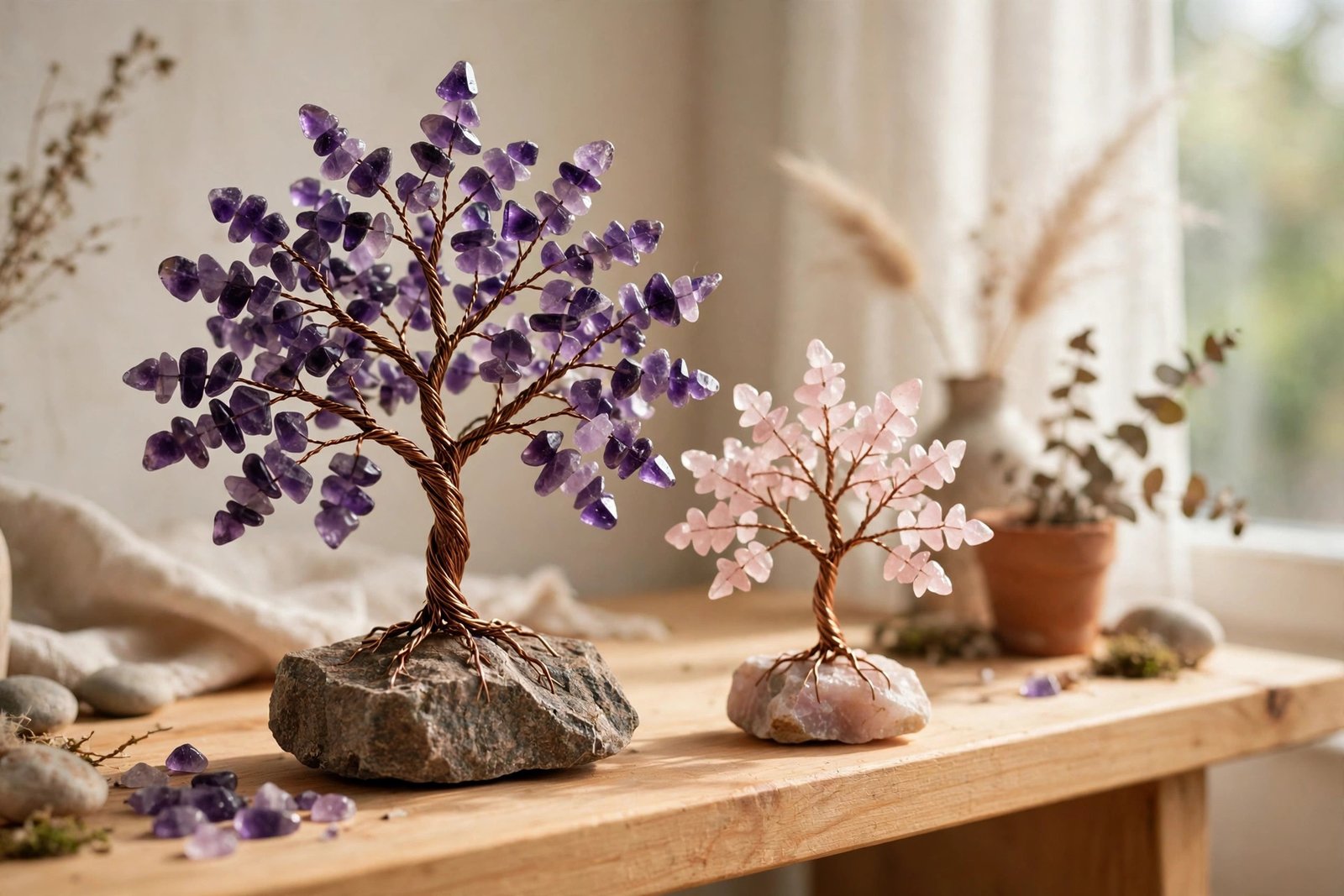
A crystal gem tree turns hundreds of tiny stone chips into a canopy: wire branches twist upward from a base, each tipped with polished chips that catch light like leaves. Sometimes called a Tree of Life, the form borrows one of humanity’s oldest symbols — a tree linking earth and sky, roots and branches — and rebuilds it in gemstone and copper wire. The result is equal parts ornament, craft piece and, in tradition, a symbol of growth and abundance.
This guide explains how gem trees are made, what they traditionally mean, which stones suit them, and where to place and how to care for one.
How a Wire-Wrapped Gem Tree Is Made
Each tree starts with a base: an agate slice, a chunk of raw crystal, a polished stone or a small wooden stand. Onto it the maker anchors a trunk formed from many strands of fine wire, usually copper, brass or silver-coloured craft wire. The strands are twisted together to form the trunk, then separated into branches and twigs, mimicking a real tree. The twisting technique relates to wire wrapping more broadly, a jewellery method described on Wikipedia’s wire wrapped jewellery page.
Leaves come last. Each twig end is threaded with one or more drilled crystal chips — the small, irregular polished pieces also sold as chip strands — and the wire is looped or twisted to lock the chip in place. A modest tree may carry a hundred chips; large statement trees carry a thousand or more. Because the chips are small and irregular, trees make beautiful use of material too tiny for beads, unlike the carefully sized beads in our guide to how crystal beads are made.
When a tree arrives, its branches are usually folded flat for shipping. Shaping it is part of the pleasure: gently fan the branches outward until the canopy looks full and balanced.
What Gem Trees Traditionally Symbolise
The Tree of Life appears in many cultures as a symbol of connection, growth, renewal and family — roots in the earth, branches reaching up, one living system. You can explore that wider symbolism on Wikipedia’s Tree of Life page. In modern crystal and feng shui-inspired practice, gem trees are traditionally associated with prosperity and steady growth, especially when made with citrine or jade-green stones and placed in a workspace or near a till. They are sometimes called money trees for this reason, a theme that connects with our guide to lucky crystals for money and wealth.
Different canopies carry different traditional emphases. Amethyst trees are linked with calm and clear thinking, rose quartz with love and harmony in the home, and multi-stone chakra trees — with seven chip colours in the branches — with overall balance. None of this is a promise of outcomes; in tradition the tree works as a daily visual reminder of the quality it represents, much as a bracelet does on the wrist.
Many AVENSU customers match a tree to the bracelet they wear: a rose quartz tree in the living room echoing the rose quartz bracelet described in our Hướng dẫn về ý nghĩa của thạch anh hồng, or a small amethyst tree beside the bed alongside an amethyst bracelet from the Cửa hàng AVENSU.
Choosing a Stone, Size and Base
Chip size and colour decide a tree’s character. Fine chips make a delicate, dense canopy; larger chips look bolder and more rustic. Single-stone trees read as calm and unified, while mixed or chakra trees bring a festive, rainbow energy. Check that chips are genuine stone if that matters to you — inexpensive trees sometimes use dyed or glass chips, and the checks in our guide on how to tell if a crystal is real help: real stone chips feel cool and noticeably weighty for their size.
Size runs from pocket trees of 5 cm to floor-standing pieces, but the most practical home sizes are 10–25 cm: large enough for the branching to read, small enough for a desk or shelf. The base matters for stability. A wide agate slice or heavy raw chunk keeps a top-heavy canopy upright, while light resin bases tip more easily. If you already collect polished slabs and slices, you will recognise the agate slice base as the same form doing structural duty.
Wire colour changes the mood too: warm copper suits citrine, aventurine and carnelian; bright silver-toned wire suits amethyst, moonstone and clear quartz; dark antique wire gives a vintage, bonsai-like feel.
Placement and Gentle Care
Traditional placement follows the symbolism: a prosperity-themed tree on a desk, in a home office or near the entrance; a rose quartz tree in a shared living space or bedroom; an amethyst tree where you read or wind down. Practically, choose a spot away from knocks, curious pets and the edge of shelves, because a falling tree bends wires and sheds chips. Keep trees out of constant harsh sunlight if the chips are colour-sensitive stones such as amethyst, which can fade over years of strong sun.
Dusting is the main care task. Use a soft, dry brush or a gentle puff of air, working from the top down, and reshape any branches that have been pressed flat. Avoid soaking a tree in water: wire can tarnish or rust at the twists, and glued bases may loosen. If a few chips fall, they can be re-threaded if the wire tail remains, or simply saved with your other mini crystal collection pieces. Occasional gentle cleansing, following the spirit of our complete crystal bracelet care routine, usually means a light wipe of the base and a few minutes of fresh air rather than any water ritual.
Các câu hỏi thường gặp
What is the difference between a gem tree and a Tree of Life pendant?
Both use the same symbol. A gem tree is a three-dimensional ornament with wire branches and stone-chip leaves standing on a base, made for display. A Tree of Life pendant flattens the design into a circular jewellery frame. Choose the tree for a room, the pendant for wearing.
Which crystal is best for a money or prosperity tree?
Citrine is the most traditional choice, long associated in crystal practice with abundance and business energy, with green aventurine and pyrite accents as popular alternatives. Treat the tree as a symbolic reminder for your work goals, and pair it with the stones discussed in our lucky crystals for money guide if you want a wearable companion.
How do I shape my gem tree when it arrives?
Unfold the branches slowly, starting from the lowest and working up. Fan each branch outward, then spread the smaller twigs so chips are not clumped. Step back and turn the tree, adjusting until the canopy looks balanced from every angle. The wire is designed to be repositioned, but avoid bending the same spot repeatedly, which weakens it.
Can I put a crystal gem tree in sunlight?
Brief daylight is fine, but constant strong sun can fade amethyst, rose quartz and fluorite chips over time and heat metal wire uncomfortably. A bright spot a little back from the window is ideal: enough light to sparkle, not enough to bleach.



 English
 Vietnamese