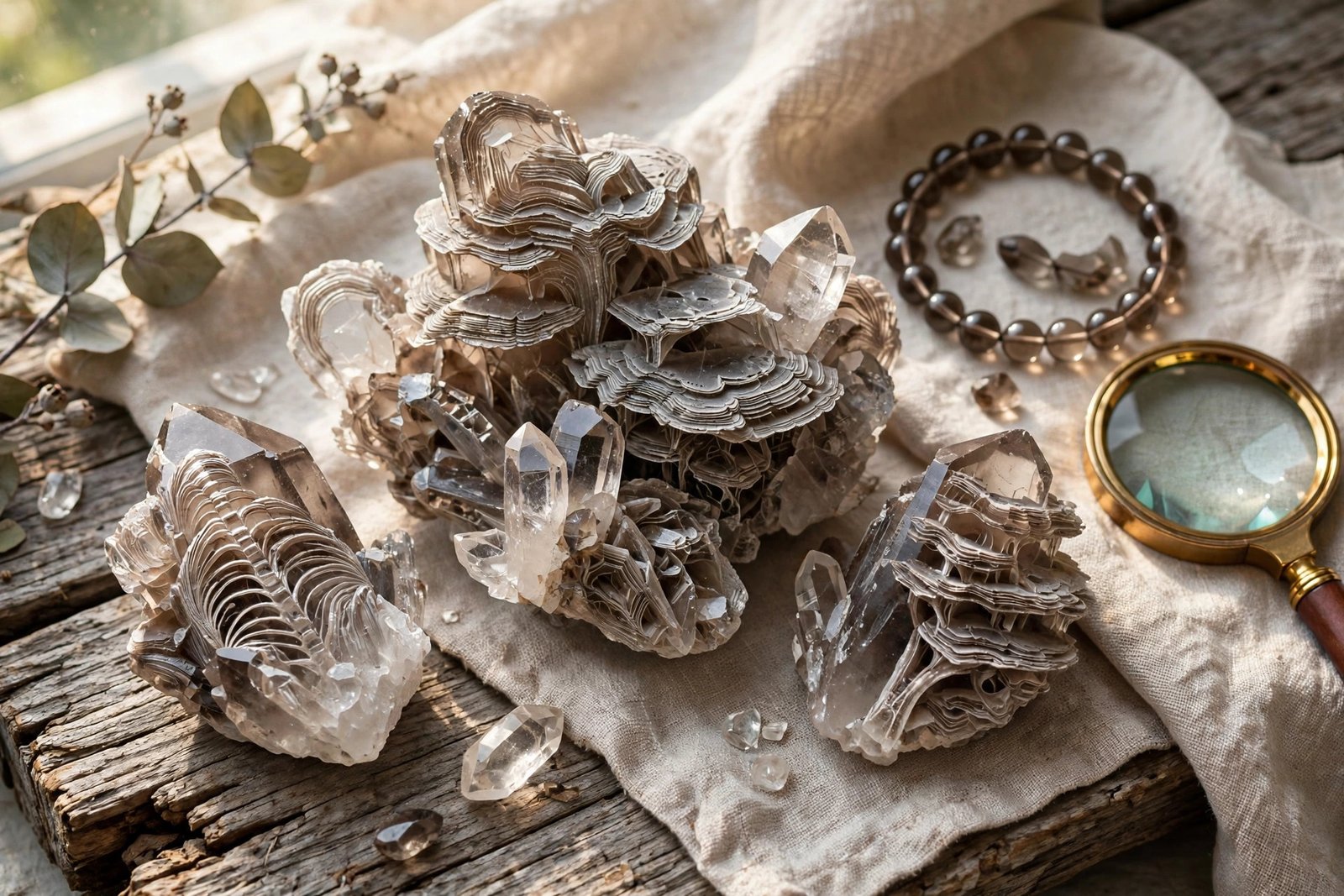
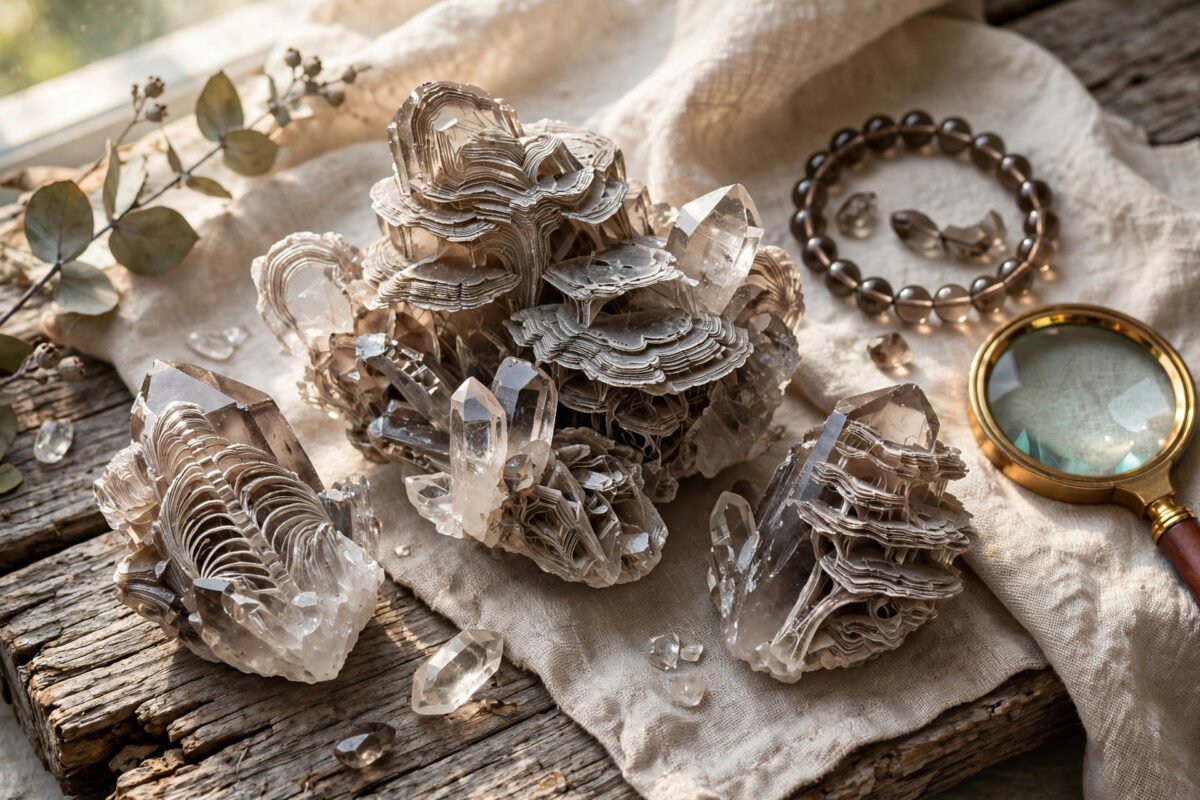
Most quartz points are admired for their clarity and clean faces. Elestial quartz is admired for the opposite: a wild, layered, deeply etched surface that looks part crystal, part sculpture. Also sold as skeletal quartz or Jacaré quartz, these specimens seem to have grown in overlapping plates and windows, with terminations scattered across the surface rather than gathered into one neat tip. Collectors prize them precisely because no two are alike.
This guide explains how elestial quartz forms, how it differs from ordinary skeletal growth, how to recognise a genuine piece, and how people traditionally work with it.
How Elestial Quartz Forms
Quartz is silicon dioxide, and its basic geology is set out in the quartz entry on Mindat, the mineral database used by collectors worldwide. Elestial specimens form when crystal growth happens in fits and starts, often in pockets where fluid chemistry keeps changing. Layers grow over earlier layers, some faces dissolve slightly while others keep building, and the result is a skeletal framework: a crystal that looks hollowed, terraced and etched, sometimes with internal cavities, water inclusions or clay trapped between the layers.
The name comes from the Portuguese celestial, via Brazil, where classic elestial quartz was first widely marketed; the related term Jacaré, meaning alligator, describes specimens whose plated surface resembles reptile skin. Much material on the market still comes from Brazil, with additional finds in Madagascar, India and a few other localities.
Because growth was interrupted and layered, an elestial often shows many small terminations across one face — sometimes called a “termination layer” — plus triangular etch marks, record-like grooves and smoky or amethyst-tinted zones. Held to the light, a good piece rewards slow turning: windows open into earlier growth stages, rather like reading tree rings.
Elestial vs Skeletal vs Ordinary Quartz
The terms overlap, and sellers do not always use them consistently, so it helps to know the spectrum. Skeletal quartz is the geological description: any quartz whose growth left internal cavities and hopper-like, frame-shaped faces. Elestial is the trade term usually reserved for skeletal quartz with heavy surface etching, multi-layered terminations and a complex, almost melted-looking exterior. A standard quartz point, by contrast, grew steadily and shows flat faces, light striations and a single termination.
Price follows complexity. Common smoky elestial pieces are reasonably affordable, while large, well-defined specimens with clear internal windows cost considerably more. If authenticity matters to you, the checks in our guide on how to tell if a crystal is real are a useful start: genuine etched quartz feels cool, shows irregular rather than stamped-looking patterning, and will not show the round air bubbles typical of glass.
It is also worth knowing that etching can be imitated by acid treatment. Artificially etched pieces tend to look uniformly frosted all over, with the same texture on every face. Natural elestial etching varies across the crystal — deep in one area, barely present in another — because it records real changes in the pocket where the crystal grew. The Wikipedia overview of quartz explains the growth environments that make such variation possible.
How Elestial Quartz Is Traditionally Used
Within crystal tradition, elestial quartz is regarded as a stone of layers and reflection. It is traditionally associated with looking beneath the surface of a situation, working through old patterns and approaching change gradually rather than all at once. Practitioners often describe it as a “slow” stone: one to sit with over weeks, turning it in the hands during journalling or quiet reflection, rather than a piece expected to produce an instant shift. These are belief-based associations, and people value the stone as a focus for their own reflection.
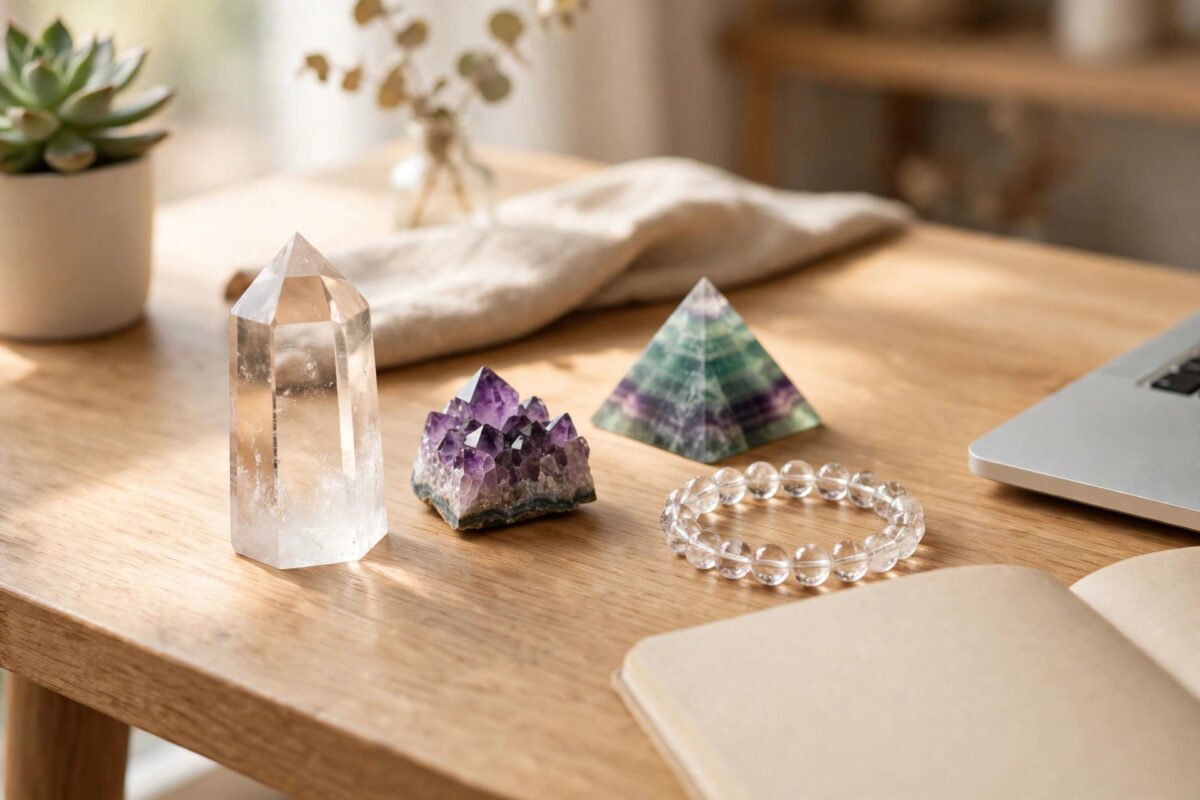
Because the pieces are raw and irregular, they are usually kept as display or meditation specimens rather than jewellery. A medium elestial on a desk or reading table pairs naturally with smoother wearable stones: many collectors keep the elestial at home and wear an AVENSU smoky quartz crystal bracelet during the day, since smoky quartz is the colour family most elestials belong to. You can browse options in the Cửa hàng AVENSU, and if grounding is your main interest, our Hướng dẫn về ý nghĩa của những viên đá định tâm explains why smoky and dark stones are traditionally chosen for that purpose, while the product page for our grounding crystal bracelet shows a wearable version.
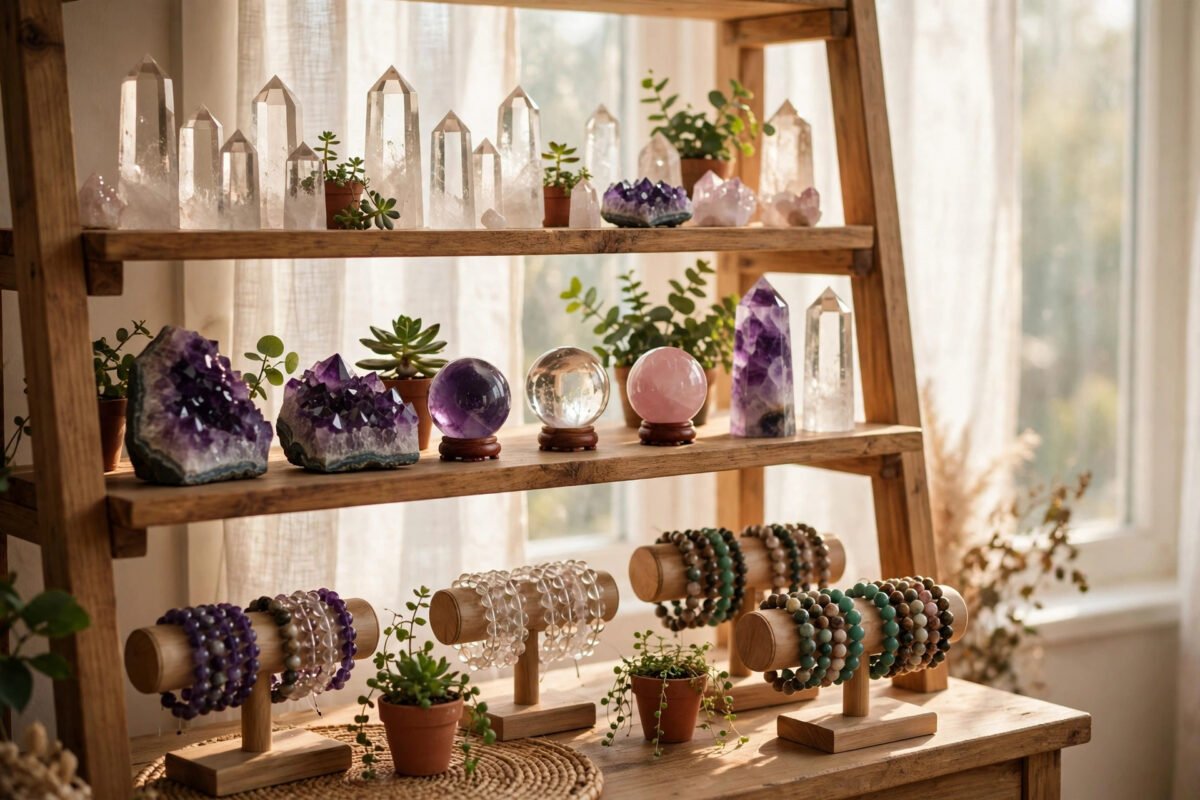
For display ideas that suit raw, sculptural pieces, see our guide to displaying a crystal collection, which covers stands and lighting for irregular specimens.
Buying and Caring for Elestial Quartz
When buying, handle the piece if you can. Look for layered terminations, varied etching and some translucency when backlit. Check for a stable base if you plan to display it standing, and inspect thin plates for cracks, since skeletal edges can be fragile. Ask about locality — Brazilian material is the classic source — and be cautious of prices that seem too low for a large, complex specimen.
Care is simpler than the wild surface suggests. Quartz is hard (7 on the Mohs scale), so the mineral itself is durable, but the thin skeletal plates can chip if knocked. Dust with a soft brush, rinse in lukewarm water to clean the crevices, and dry thoroughly so water does not sit in internal cavities. Avoid dropping the piece onto hard floors and store it separately from softer stones it could scratch — and from harder pieces that could damage its fine edges. The hardness-based storage approach in how to store crystal bracelets applies to specimens too, and our complete crystal bracelet care routine explains gentle cleansing methods that are equally safe for raw quartz.
Các câu hỏi thường gặp
Is elestial quartz the same as skeletal quartz?
They are closely related. Skeletal describes the growth habit — a hollow, layered framework — while elestial is the trade name for skeletal quartz with especially heavy etching and multi-layered terminations. Most elestial pieces are skeletal, but not every skeletal quartz is sold as elestial.
Why does elestial quartz look melted or etched?
Because it grew in changing conditions. As fluids in the crystal pocket shifted, some layers partly dissolved while others kept growing, leaving terraces, windows and etch patterns. That interrupted growth is exactly what collectors value, since it records the crystal’s history on its surface.
Is elestial quartz rare or expensive?
Small to medium smoky elestial pieces are common enough to be affordable. Large specimens with dramatic layering, clear windows or unusual colour zoning are scarcer and priced accordingly. As with most minerals, size, complexity and condition matter more than the name alone.
Can elestial quartz be worn as jewellery?
Occasionally, small elestial points are set as pendants, but the fragile plates and irregular shapes make specimens better suited to display and hand-held reflection. For daily wear, a polished smoky quartz bracelet gives you the same colour family in a durable form.



 English
 Vietnamese