The bracelet on your wrist began as a rough chunk of stone in the ground — dusty, angular and nothing like the smooth, glowing beads you slide over your hand. Between the mine and your wrist lie cutting rooms, tumbling barrels, drilling machines and the hands of the person who strung, knotted and checked your bracelet before it was packed. Understanding that journey explains a lot: why beads vary slightly, why some stones cost more than others, and how to judge quality when you buy.
This article follows a crystal bracelet through every stage, from rough rock to retail shelf.
Stage One: Mining, Sorting and Grading the Rough
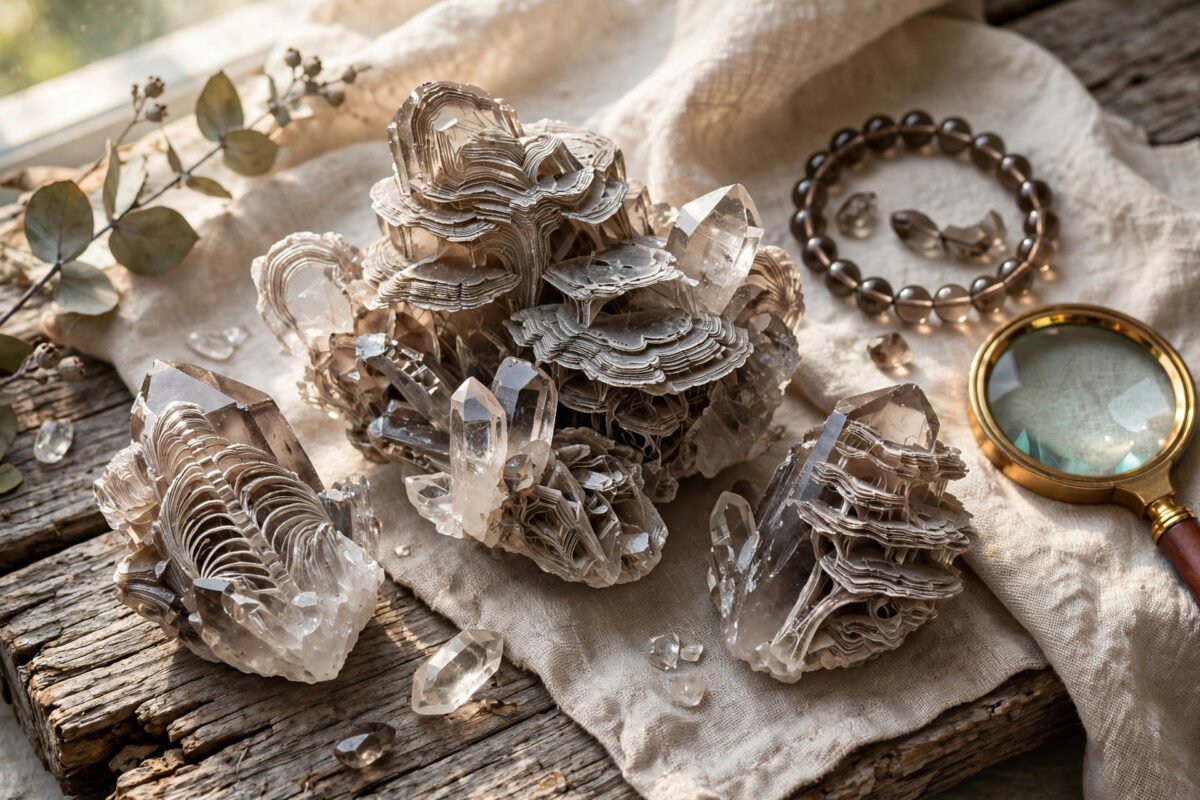
Most bracelet stones — quartz varieties, agates, jaspers, amethyst — are mined as part of larger mineral operations or collected from deposits where the material occurs in quantity; geological background for quartz, the largest family used in bracelets, is available from Mindat’s quartz entry. At the workshop, rough material is washed and sorted by colour, clarity and freedom from cracks. This grading decides a stone’s future: the clearest, richest-coloured rough becomes beads and carvings, heavily included material becomes tumbled stones, and fractured pieces are discarded or crushed for other uses.
Grading is the first reason prices differ. Two rose quartz bracelets may look similar in a photo, but one was cut from a small top-grade parcel with even pink colour, while the other came from pale, cloudy rough. Our Hướng dẫn về ý nghĩa của thạch anh hồng shows the depth of colour buyers look for in that stone.
Stage Two: Cutting and Shaping the Beads
Rough chunks are sawn into cubes or rough bead blanks slightly larger than the finished bead. The blanks are then shaped — traditionally in rotating drums or on grinding wheels — until they approach a sphere. Diameter is controlled carefully, because a bracelet’s look depends on its beads matching: the common sizes and how they wear are explained in our bracelet bead size guide.
This stage is slow and material-hungry. A surprising share of the original stone is ground away as dust and slurry, which is one reason larger beads cost disproportionately more: a 12 mm bead needs a much bigger flawless cube of rough than an 8 mm bead does. Hardness matters throughout — quartz, at 7 on the Mohs scale described in Wikipedia’s Mohs scale overview, grinds more slowly than softer stones such as lapis or turquoise, and each mineral needs its own wheels and timing.
Stage Three: Drilling, Tumbling and Polishing
Each shaped bead is drilled through its centre, usually with a diamond-tipped or ultrasonic drill, working from both sides to meet in the middle and avoid exit chips. Hole size is chosen to suit elastic cord — large enough to string smoothly, small enough to look neat.
After drilling, beads are tumbled and polished in stages, moving through finer and finer abrasives until the surface turns from matte to glossy. This is where the stone’s character appears: agate banding sharpens, labradorite’s flash wakes up, amethyst deepens (its colour background is in our amethyst meaning guide). Polishing also reveals flaws that sorting missed, so beads are graded again here: matched for colour and size, with cracked or dull pieces removed. The beads for one bracelet are selected as a set at this point, not grabbed at random — which is why a good bracelet looks harmonious all the way around.
Simple checks from how to tell if a crystal is real work at retail because of this process: natural beads show slight variation in tone and tiny inclusions, while perfectly identical, bubble-filled beads point to glass.
Stage Four: Stringing, Knotting and Sizing
Finished beads are strung on elastic cord — a multi-strand or single strong elastomer chosen for stretch and durability. The stringer counts beads to the bracelet’s target size, following the wrist-measurement logic in our crystal bracelet sizing guide: too few beads and the bracelet pinches and strains the cord; too many and it slides and knocks against desks.
The knot is the bracelet’s most engineered detail. A surgeon’s knot or similar secure knot is tied under tension, often with a tiny touch of jeweller’s adhesive, then tucked inside the bead beside it so no knot shows. A well-made bracelet hides its knot completely and stretches evenly without gaps opening between beads. At AVENSU, bracelets such as our Vòng tay pha lê giúp cân bằng năng lượng are finished this way, and every piece is stretch-tested before packing: pulled firmly several times to confirm the knot holds and the elastic recovers.
Stage Five: Quality Control and Retail
Before a bracelet is photographed and listed, it is checked bead by bead under good light: polish even, holes clean, no chips at the drill points, colour consistent, knot invisible, size correct on a sizing mandrel. It is then cleaned, because workshop dust dulls even the best polish, and rested — elastic that has just been knotted is left to settle so the bracelet keeps its shape.
From there it joins the retailer’s range — you can see the finished results in the Cửa hàng AVENSU — and eventually reaches a wrist. The care that keeps it looking as it did on day one is in your hands after that: the habits in our complete crystal bracelet care routine and a few essentials from the crystal care kit essentials guide will keep the polish, cord and colour in workshop condition for years.
Knowing the journey also makes you a better buyer: slight natural variation is the signature of real stone and real workmanship, and the bracelet that looks alive rather than stamped out is usually the one that was graded, matched and knotted by someone paying attention.
Các câu hỏi thường gặp
Why do beads in a natural crystal bracelet vary slightly?
Because they were cut from natural rough, not moulded. Sorting and matching keep the variation subtle and harmonious, but gentle differences in tone, pattern and inclusions are normal — and are one of the simplest signs that a bracelet is genuine stone rather than glass or resin.
What cord is used inside a crystal bracelet?
Most stretch bracelets use strong elastic cord, chosen in a thickness that suits the bead size and hole diameter. It is knotted securely under tension, the knot is often reinforced with a touch of jeweller’s adhesive, and it is hidden inside an adjacent bead. Quality bracelets are stretch-tested before sale.
Why do larger crystal beads cost more?
Yield. A large bead requires a bigger, flawless cube of rough to begin with, and most of that cube is ground away during shaping. Suitable rough for 12 mm beads is far scarcer than rough for 6 mm beads, so the price rises faster than the size does.
How can I judge a bracelet’s quality when buying?
Look for even polish, beads matched in size and colour, clean drill holes without chips, no visible knot, and an elastic that stretches smoothly without gaps appearing between beads. Check the stated size against your wrist measurement, and buy from sellers who describe the actual stone and show natural variation honestly.





 English
 Vietnamese