You are sitting at your desk when it happens: a soft pop, a scatter of beads across the floor, and your favorite crystal bracelet lying in pieces. The first feeling is surprise; the second, for many people, is unease. Did it mean something? Before you spiral, take a breath. Most broken bracelets have thoroughly ordinary explanations — and every single one can be handled with calm, practical steps. Here is why crystal bracelets break, what the traditions say it means, and exactly what to do next.
The Practical Reasons: Why Bracelets Really Break
In nine cases out of ten, a broken bracelet is a maintenance story, not a mystery. Elastic cord — the stretchy strand inside most beaded bracelets — has a finite lifespan. Every stretch, every pull over your hand, every exposure to perfume, sunscreen, or sweat weakens it slightly. After six to eighteen months of daily wear, most cords are living on borrowed time. The stringing material itself matters too — our elastic vs wire durability comparison explains which cord type actually lasts longer.
- Elastic fatigue. The cord stretches a little more each time and does not fully spring back. One day it simply gives way — often while you are doing nothing dramatic at all.
- Knot failure. Factory knots can loosen over time, especially with temperature swings. If your bracelet had a slowly widening gap between beads, the knot was warning you.
- Bead flaws. A bead with a rough drill hole acts like a tiny saw on the cord. One sharp edge, months of friction, and the cord parts from the inside.
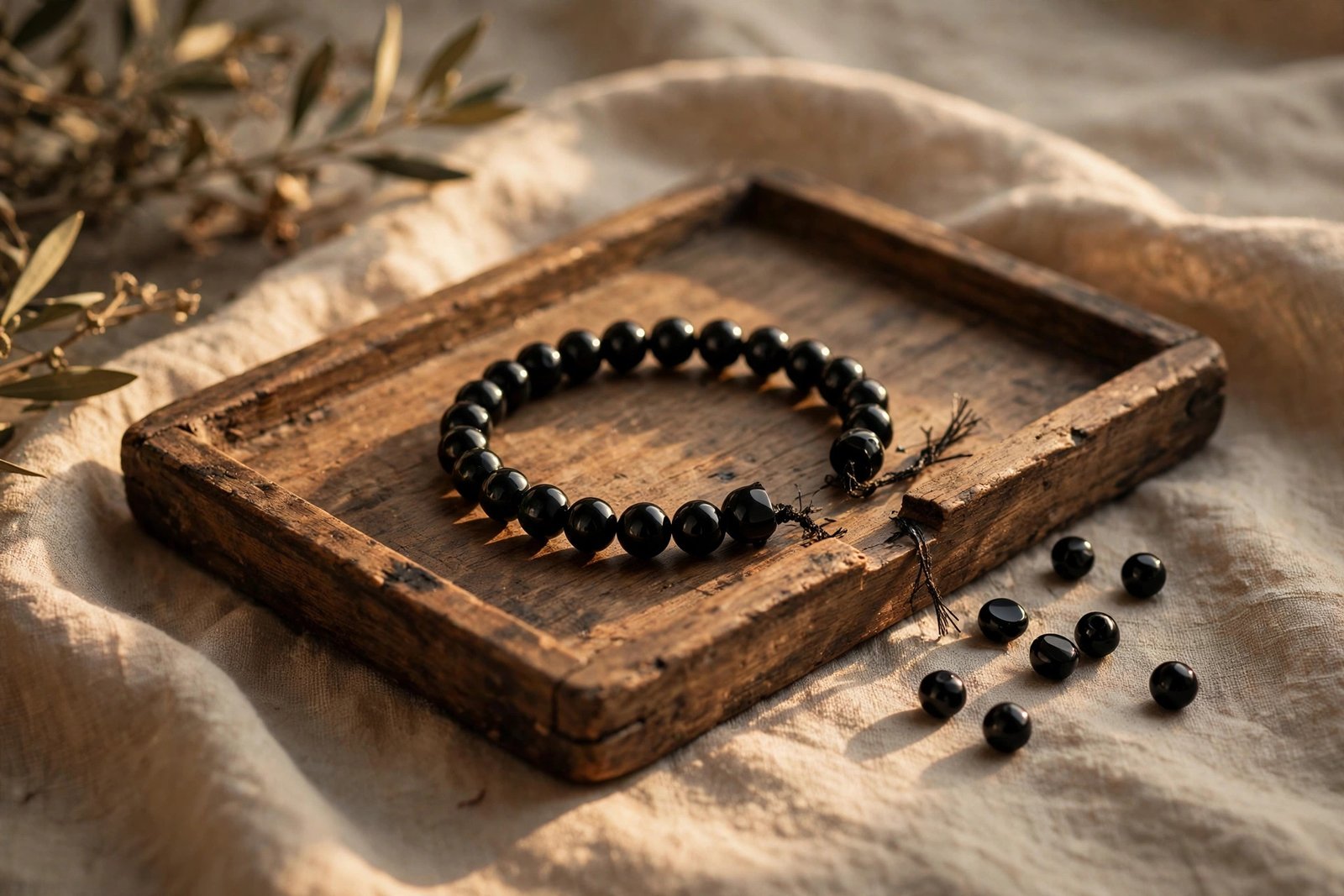
- Sudden impact. Catching the bracelet on a door handle, a bag strap, or a glove yanks the cord past its limit in an instant. Obsidian, being a natural volcanic glass with a hardness of 5–6 on the Mohs scale, is strong but brittle — the bead usually survives, the cord does not.
- Chemical wear. Perfume, hand sanitizer, and household cleaners degrade elastic fast. Spraying fragrance directly over a bracelet is one of the quickest ways to shorten its life.
The Traditional Interpretation: What Breakage Is Believed to Mean
Beyond the practical causes, crystal traditions offer a symbolic reading — and many wearers find it genuinely comforting. A broken crystal bracelet is traditionally interpreted as a sign that the stone has absorbed as much heavy energy as it could hold, like a sponge that is finally full. In this reading, the break is not a failure; it is a completion.
It is also traditionally interpreted as a signal of a completed chapter: a protection stone breaking when a stressful period ends, or a love stone snapping as a relationship shifts. Some wearers read the timing — what was happening in your life that week? — as the message. Others simply see it as the bracelet’s way of saying its work here is done.
Take the interpretation that resonates and leave the rest. The traditions are meant to bring comfort and closure, not worry. No tradition worth following suggests that a broken bracelet brings bad luck — quite the opposite.
What to Do Next: A Calm 4-Step Plan
Step 1: Pause and gather
Resist the urge to sweep beads into the trash in frustration. Collect every bead you can find, including the tiny spacer beads and the cord remnants. Check under furniture and inside sleeves — beads roll surprisingly far. Place everything in a small bowl.
Step 2: Decide — repair or release
Ask two questions. Is every bead intact, and do you still love this bracelet? If yes to both, it is a repair job: restringing a crystal bracelet at home takes about twenty minutes and costs almost nothing. If beads are cracked or the bracelet no longer feels like yours, it may be time to release it — more on that below.
Step 3: Cleanse the beads before restringing
Before the beads go back on a new cord, give them a fresh start. A quick smoke cleanse, a moonlight rest, or simply wiping each bead with a soft cloth while setting a new intention all work. The ritual matters more than the method: it marks the bracelet’s new chapter. If you are unsure whether the elastic was already tired, our guide to when elastic bracelets need restringing shows the warning signs to check.
Step 4: Replace what is missing
Lost a bead or two under the sofa? You have options: restring slightly shorter, add a complementary bead from another bracelet, or use it as an excuse to start fresh. An obsidian protection bracelet makes a strong successor piece — obsidian is traditionally associated with shielding, and starting a new protection bracelet after a break feels symbolically right.
When to Let Go Instead of Repairing
Sometimes the kindest choice is to retire the bracelet. If beads are chipped, the elastic has been repaired multiple times, or you simply feel done with the piece, release it with gratitude rather than guilt. Burying beads in soil, placing them in a plant pot, or returning them to nature at a favorite spot are all traditional ways to say thank you and let go.
“A broken bracelet is not a broken promise. It is a finished chapter — and finished chapters are how you know the story is moving forward.”
For more practical bracelet know-how, explore our crystal bracelet guides, and wear your next bracelet with the quiet confidence that even endings are part of the practice.
Frequently Asked Questions
What does it mean when a crystal bracelet breaks?
Practically, it usually means the elastic cord wore out — the most common cause by far. Symbolically, it is traditionally interpreted as a sign that the stone has completed its work or absorbed heavy energy. Treat it as a completed chapter, not a bad omen.
Can a broken crystal bracelet be fixed?
In most cases, yes. If the beads are intact, restringing on fresh elastic cord restores the bracelet completely and takes about twenty minutes at home. Only cracked or chipped beads cannot be saved.
Should I keep wearing a bracelet that broke and was repaired?
Absolutely. A restrung bracelet is as good as new — arguably better, since you chose the cord, tied the knot, and set the intention yourself. Many wearers feel more connected to a bracelet they repaired with their own hands.
Is it bad luck if my crystal bracelet breaks?
No. Across crystal traditions, breakage is read as completion or release, never as a curse. If the break unsettles you, a small cleansing ritual and a moment of gratitude for the bracelet’s service usually settles the feeling completely.









 English
 Vietnamese