The last hour before sleep decides the first hour of it. Most of us spend that hour scrolling, answering one more message, and carrying the day’s unresolved loops straight into bed. A crystal ritual for better sleep is not about magic — it is about building a consistent wind-down sequence that tells your nervous system the day is over. Your nightstand becomes the stage, your bracelet the anchor, and the ritual the off-ramp from a busy mind to a quiet one.
Why a Nightstand Setup Matters
Sleep researchers emphasize the importance of a wind-down routine: the same cues, in the same order, each night, train your brain to associate them with sleep onset. A physical setup helps because it removes decisions. When the bracelet is already on the nightstand and the lamp is already dimmed, you do not have to think — you just begin.
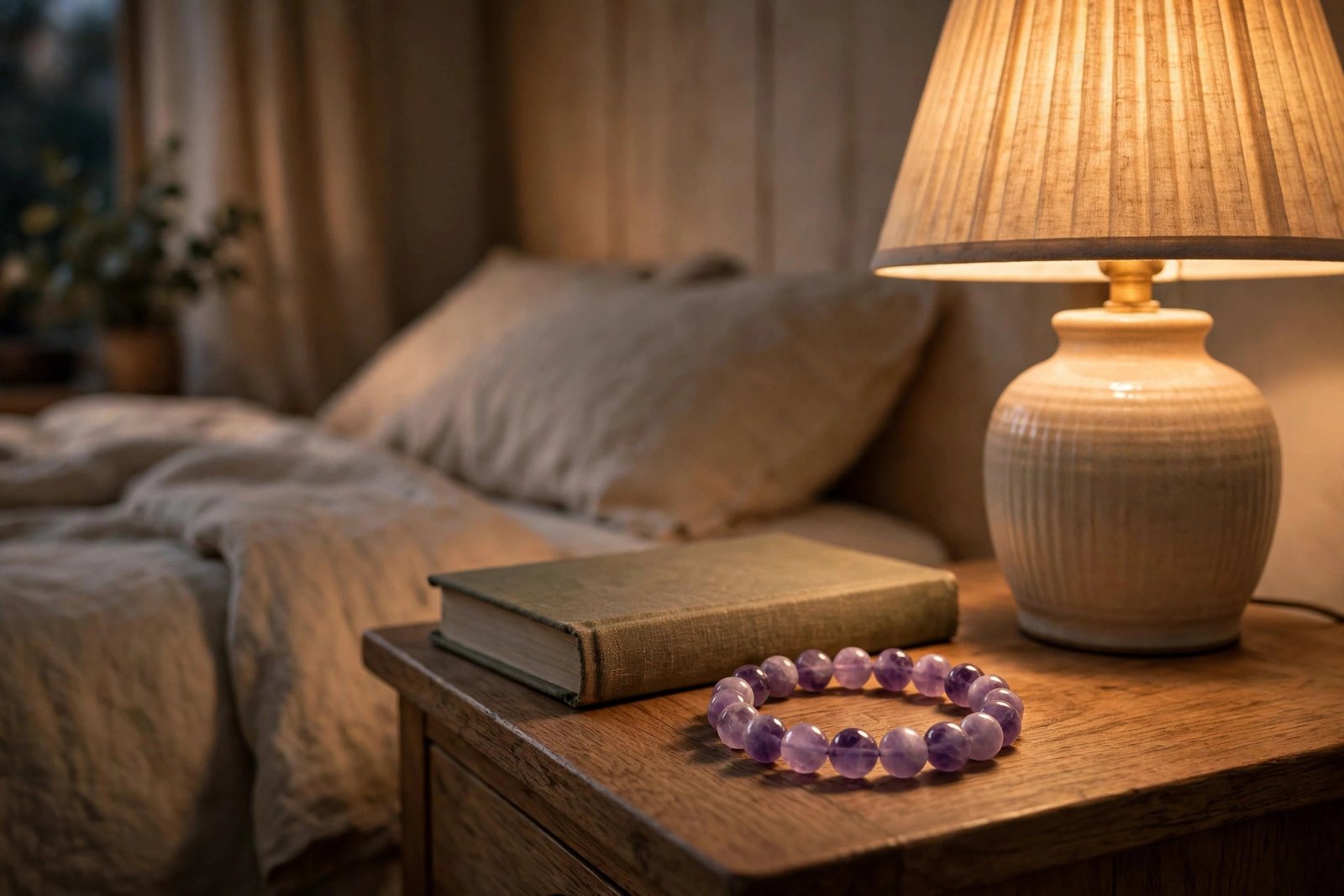
Amethyst is the traditional stone for evening rituals. Its violet color is visually calming, and it is traditionally associated with tranquility and restful evenings — fitting for a stone whose name comes from the Greek word for “not intoxicated,” as you can read on the amethyst page. A lavender crystal bracelet on your nightstand becomes the visual cue that the wind-down has started. A related pale-violet stone worth knowing is lavender quartz, the tranquility stone, which shares the soft look with its own calming tradition. Find more evening practices in our crystal rituals collection.
The Nightstand Setup: What to Place and Where
- Your bracelet, top center. Take it off and place it deliberately on the nightstand — this gesture is the ritual’s starting bell. A lavender amethyst piece or a moonstone bracelet, traditionally linked with nighttime calm, both work.
- A small dish or tray. Corrals the bracelet and any small stones, and keeps the ritual feeling intentional rather than cluttered.
- A warm, dim lamp. Overhead light is the enemy of wind-down. A low-wattage warm bulb or candle-style LED signals evening to your brain.
- A book (paper, not a screen). Even ten pages of fiction helps the mind disengage from the day’s open loops.
- Water. A glass of water removes the “I should get up” excuse that breaks the wind-down.
Keep the phone out of this zone entirely — ideally charging in another room. No ritual survives a notification.
The 15-Minute Evening Ritual, Step by Step
Step 1 — The Transition (2 minutes)
When you are done with screens for the night, go to the bedroom and dim the lamp. Remove your bracelet slowly and place it on the tray. This single deliberate action marks the boundary between day and night.
Step 2 — The Bead Review (3 minutes)
Hold the bracelet and move through the beads one by one. With each bead, name one thing from the day — good, bad, or neutral. You are not analyzing, just acknowledging. This externalizes the mental replay loop that otherwise runs in bed. Our amethyst night ritual uses a similar bead-by-bead review and pairs well with this setup.
Step 3 — The Release Breath (3 minutes)
Set the bracelet down. Place one hand on your chest and breathe in for four counts, out for six. On each exhale, silently name one thing you are done with today — “the deadline,” “the traffic,” “the argument.” Six slow cycles is enough.
Step 4 — Tomorrow’s Parking Lot (2 minutes)
Keep a small notepad on the nightstand. Write down anything your mind insists on carrying into tomorrow — tasks, worries, reminders. This is a parking lot, not a to-do list: the point is to give your brain permission to stop holding it.
Step 5 — Read and Rest (5 minutes)
Read a few pages of your book with the bracelet resting on the tray beside you. When your eyes get heavy, put the book down, turn off the lamp, and sleep. The bracelet stays on the nightstand — many people find wearing it to bed uncomfortable, and the ritual’s power is in the sequence, not in overnight contact.
Adapting the Ritual for Real Life
- Travel version: Pack the bracelet in a small pouch and do the bead review plus release breath in bed. The notepad can be your phone’s notes app — opened once, then closed.
- Shared bedroom: Do steps 1–4 at a chair or desk before getting into bed, so a partner’s different schedule does not interrupt the sequence.
- Restless nights: If you wake at 3 a.m. with a racing mind, reach for the bracelet on the tray and do the bead review again — slowly. Do not check the time.
“You cannot force sleep, but you can build the conditions it likes. A ritual is just a set of conditions you can repeat — and repetition is what turns a restless evening into a reliable one.”
To build your own setup, start with the lavender crystal bracelet — its soft violet beads are the classic nightstand stone, traditionally associated with calm and restful evenings. If you prefer a cooler, moonlit feel, the moonstone bracelet is a beautiful alternative. And for a weekly reset that keeps the practice fresh, our Sunday reset ritual includes a bracelet-cleansing step that pairs nicely with a fresh week of evening routines.
Frequently Asked Questions
Should I wear the bracelet while sleeping?
It is a matter of comfort. Most people sleep better without a bracelet on — elastic can catch on bedding and beads can press into the wrist. The ritual works through the wind-down sequence, so leaving the bracelet on the nightstand tray loses nothing.
Can this ritual help with an overactive mind at bedtime?
The bead review and the “parking lot” notepad are specifically designed for that problem: they give racing thoughts somewhere to go before bed. Think of this as a mindfulness routine that supports your wind-down — not a treatment for any sleep condition. If sleeplessness persists, talk to a healthcare professional.
What if my partner has a different bedtime?
Do the active steps (transition, bead review, release breath, parking lot) earlier in the evening at a chair or desk, and keep only the reading step for bed. The ritual’s power comes from its consistent sequence, not from doing it in bed.
How long before I notice a difference?
Most people report that the routine itself feels calming within the first few nights — the consistency is the point, not a dramatic transformation. Give it two full weeks of nightly practice before judging whether the sequence suits you.
















 English
 Vietnamese