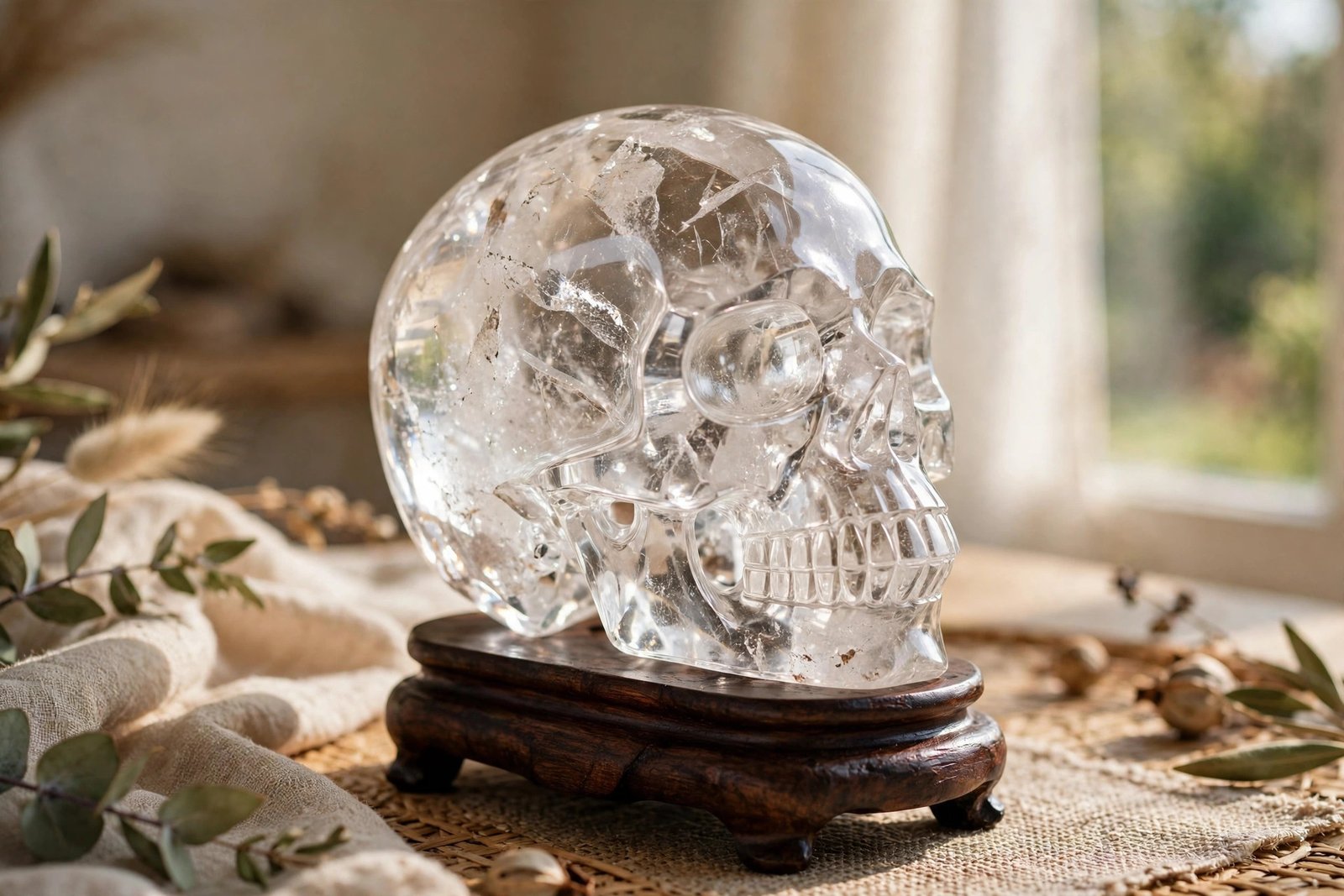
Few crystal carvings inspire as much curiosity as the crystal skull. Part artifact, part legend, and part modern art form, skulls carved from quartz and other stones have moved from museum controversies to the shelves of everyday collectors. Their story mixes genuine craftsmanship, a famous hoax, and a thriving contemporary carving tradition.
This guide separates the documented history from the mythology, explains how modern crystal skulls are made, and explores why people collect them today. If carved figures appeal to you, you will also find gentler starting points in the AVENSU shop and in our wider carving guides linked below.
The Famous Museum Skulls
In the late nineteenth and early twentieth centuries, several life-size quartz skulls appeared in museums and private collections, including pieces held by the British Museum and the Smithsonian Institution. They were promoted as pre-Columbian artifacts from Aztec or Maya cultures, and their flawless polish fueled speculation about lost technologies and ancient mysteries.
Modern testing told a different story. Microscopic analysis revealed marks from rotary tools and modern abrasives, showing that the famous large skulls were carved in the nineteenth century, most likely in Europe, and artificially aged. The Smithsonian’s research on its own skull is a fascinating read in scientific detection, and Wikipedia’s crystal skull overview summarizes the investigations clearly.
None of this makes the skulls worthless as objects. They remain superb examples of lapidary skill and a lesson in how a good story can outrun evidence — which is precisely why reputable sellers today describe modern skulls honestly as contemporary carvings.
Legends, Films, and Popular Imagination
The debunked museum pieces inspired a generous mythology: skulls said to hold ancient knowledge, healing powers, or a complete set of thirteen that would one day reunite. Hollywood amplified the legend, most famously in an Indiana Jones adventure, and the crystal skull became a pop-culture icon recognized far beyond collecting circles.
In crystal tradition, skulls are believed to symbolize wisdom, ancestry, and the acceptance of life’s cycles. Practitioners traditionally associate quartz skulls with memory and meditation, treating them as contemplative objects rather than curiosities. As with all such associations, these are matters of belief and personal meaning, never proven effects — and enjoying a skull simply as a dramatic carving is reason enough to own one.
If the contemplative angle appeals to you, smaller carved figures offer a softer entry point. Our guide to crystal angel carvings explores guardian figures, while carved crystal animals covers animal symbolism in carving.
How Modern Crystal Skulls Are Carved
Today’s skulls are carved openly as art. A lapidary starts with a solid block of quartz, amethyst, obsidian, or another hard stone, sketches the proportions, and roughs out the shape with diamond saws and grinding wheels. Fine detail — eye sockets, teeth, the curve of the cranium — is refined with smaller burrs, followed by hours of sanding and polishing. Even a palm-sized skull can take a skilled carver days to complete.
Styles range from realistic anatomical pieces to stylized alien or sugar-skull designs. Sizes range from tiny one-inch carvings to statement pieces several kilos in weight. Prices follow size, material, and the carver’s reputation; signed work by recognized carvers, particularly from Brazil and Germany’s Idar-Oberstein tradition, commands a premium.
Quartz skulls show the carving best because the stone’s clarity reveals internal rainbows and veils. To judge quality, check symmetry, the smoothness of the polish inside the eye sockets, and whether the base sits flat. Learning how to tell if a crystal is real will help you spot glass imitations, which are common in cheap skull carvings.
Why People Collect Crystal Skulls Today
Modern collectors give varied reasons: admiration for the craftsmanship, the skull’s long tradition as a memento mori in art, meditation practice, or simply the pleasure of a dramatic object that starts conversations. Some build themed collections by material — a skull in every stone — while others keep a single significant piece.
Skulls also pair naturally with wearable collections. Many AVENSU customers who display a quartz skull also wear an AVENSU amethyst or clear quartz bracelet, keeping a favorite stone present in both their space and their day. Whatever your reason, care for a skull as you would any fine carving: dust with a soft brush from a crystal care kit, wash quartz pieces in lukewarm water, and store padded so the teeth and nose — the most fragile details — cannot chip. Our complete crystal bracelet care routine covers the same gentle principles for jewelry.
Frequently Asked Questions
Are crystal skulls really ancient?
The famous life-size museum skulls were shown by tool-mark analysis to be nineteenth-century carvings, not pre-Columbian artifacts. Modern skulls are sold honestly as contemporary art, and that is how you should buy them.
What is the best stone for a crystal skull?
Clear quartz is the classic choice for its clarity and detail. Amethyst, smoky quartz, and black obsidian are also popular; choose the material whose color and traditional associations appeal to you most.
Are crystal skulls a good first carving?
A small, palm-sized skull is an affordable way to start. If skulls feel intense, begin with animal or angel carvings and add a skull when the symbolism draws you in.
How do I clean a crystal skull?
Use a soft brush for the eye sockets and teeth, wash quartz with lukewarm water and mild soap, and dry carefully. Avoid ultrasonic cleaners on pieces with fine detail.



 English
 Vietnamese