A crystal grid is an arrangement of stones laid out in a deliberate pattern — a circle, a flower of life, a simple cross — with one central stone and supporting points around it. The points are the grid’s working parts: their tips are traditionally believed to direct energy toward or away from the centre. Choosing the right points decides whether a grid looks harmonious or feels like a scatter of unrelated stones.
This guide covers choosing a centre stone, point sizes and shapes, matched sets, and building your first grid.
The Centre Stone: Generator, Tower or Cluster
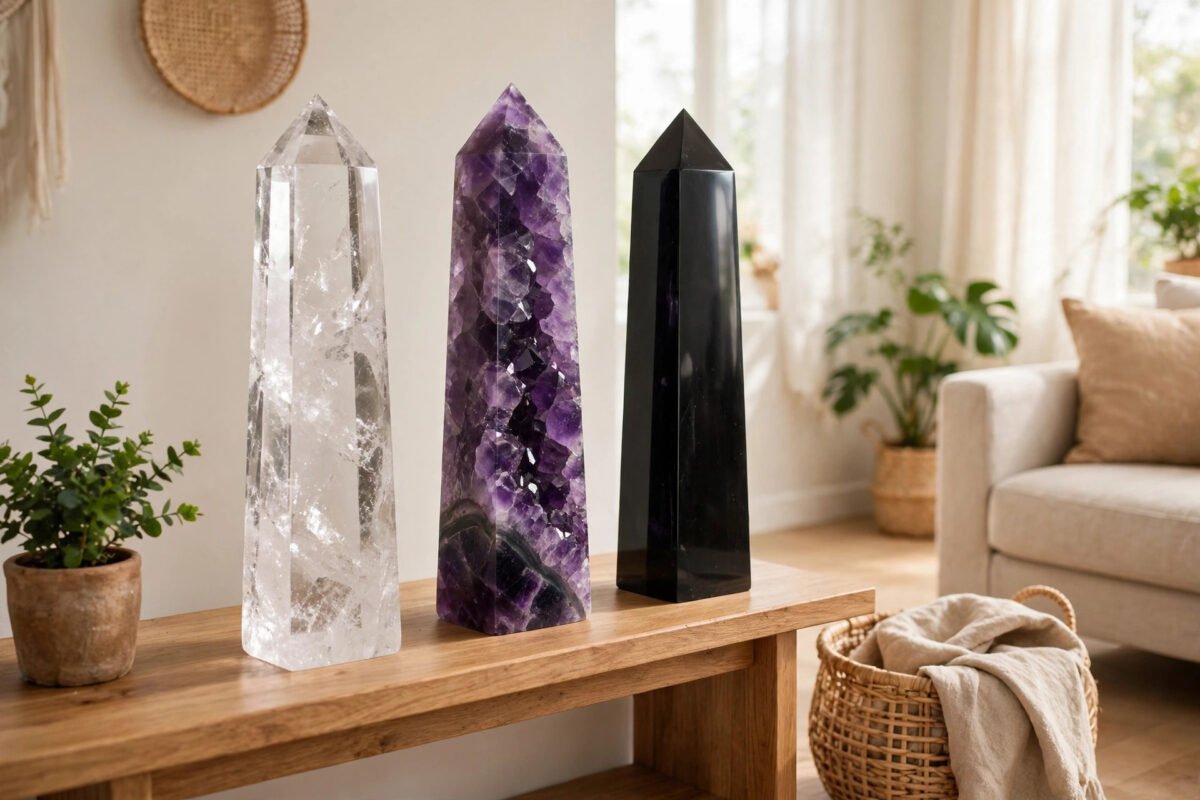
Every grid starts with its centre, the tallest and most visually commanding piece. A generator crystal point, with six equal faces meeting at one tip, is the traditional favourite because its geometry is believed to focus the whole arrangement upward and outward from a single apex. A polished tower works nearly as well and offers more stone choices, while a small cluster gives a softer, multi-directional feel suited to grids meant for a whole room rather than a single intention.
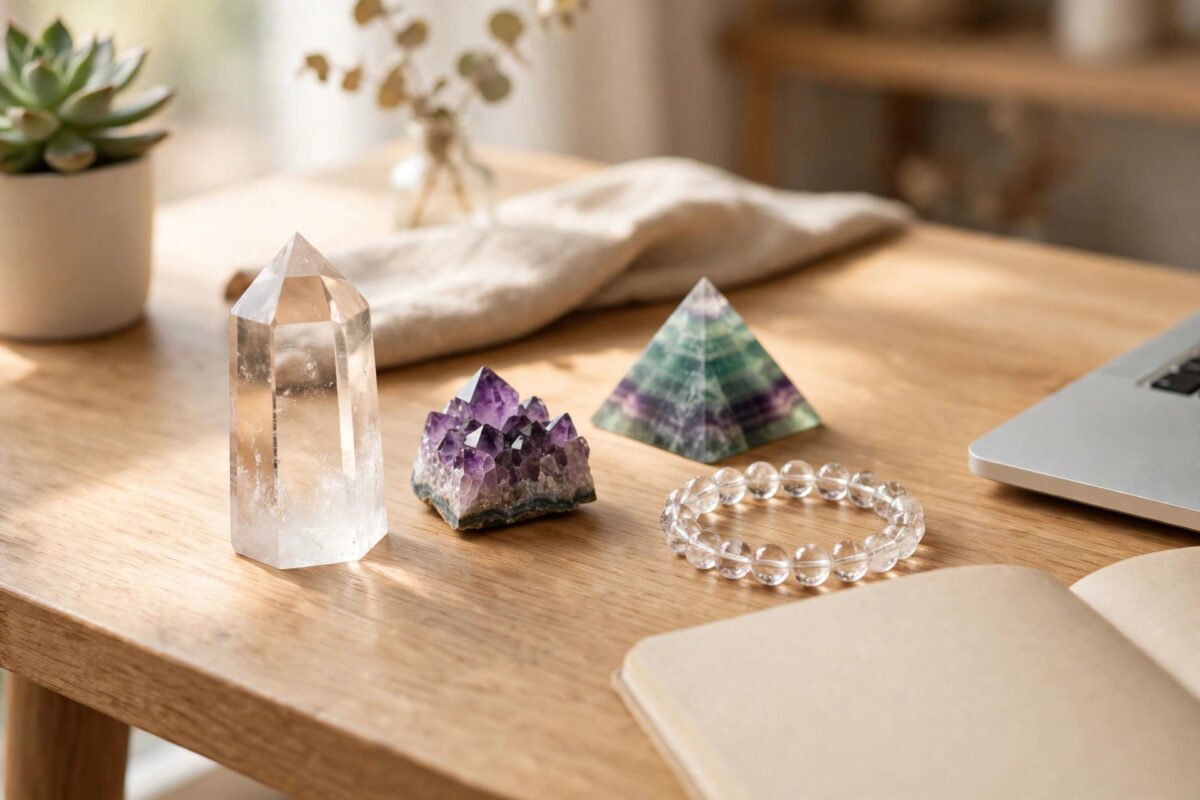
Centre size sets the scale of everything else. As a rule of thumb, the centre should be roughly two to three times the height of the surrounding points, so the eye reads a clear hierarchy. For a desk grid, a centre of 7–10 cm with satellite points of 3–4 cm looks balanced; for a small tray or travel grid, scale down in the same proportion, as suggested for the miniature layouts in our mini crystal collections guide.
Clear quartz is the most versatile centre because tradition treats it as a general amplifier that pairs with any supporting stone. Amethyst centres suit calm, evening-themed grids; citrine centres suit bright, goal-focused ones. If your grid celebrates a particular stone, let the centre and at least some satellites share it, echoing the stone-pairing logic used in wearable pieces such as an AVENSU amethyst bracelet from the AVENSU shop.
Choosing Point Sizes and Shapes for the Ring
Satellite points come in three main forms. Natural single points, unpolished or lightly polished, have authentic crystal faces and a rustic look. Polished mini towers stand upright reliably, which matters on flat grid boards. Double-terminated points, with a tip at each end, are traditionally believed to move energy in both directions and are often laid flat pointing along the grid’s lines rather than standing.
Orientation is a genuine design choice. In grid tradition, points facing inward are believed to draw energy toward the centre, while points facing outward are believed to project the grid’s effect into the room. Many builders mix: an inner ring facing in, an outer ring facing out. Whatever you choose, be consistent within each ring, since consistency makes a grid read as one pattern rather than a collection of stones. The geometry background in Wikipedia’s article on crystal grids’ underlying sacred geometry explains why these repeated patterns feel so satisfying to the eye.
Size matching matters more than perfection. Satellites within a ring should be close in height and girth — variations of a few millimetres disappear in a pattern, but one much larger point pulls the whole grid lopsided. When buying loose points, order a few more than the pattern needs and select the best-matched ones for the grid, keeping spares for future layouts or for the kind of small displays described in our crystal moon and star carvings guide.
Matched Sets: Buying Points That Belong Together
A matched set is a group of points cut from similar material to similar dimensions, sold together for grid work. Sets remove the guesswork of matching and guarantee colour consistency — six amethyst points of the same purple depth look intentional, while six gathered over a year from different shops rarely match. Sets commonly come in fours, sixes, eights and twelves, following the symmetry of popular grid patterns.
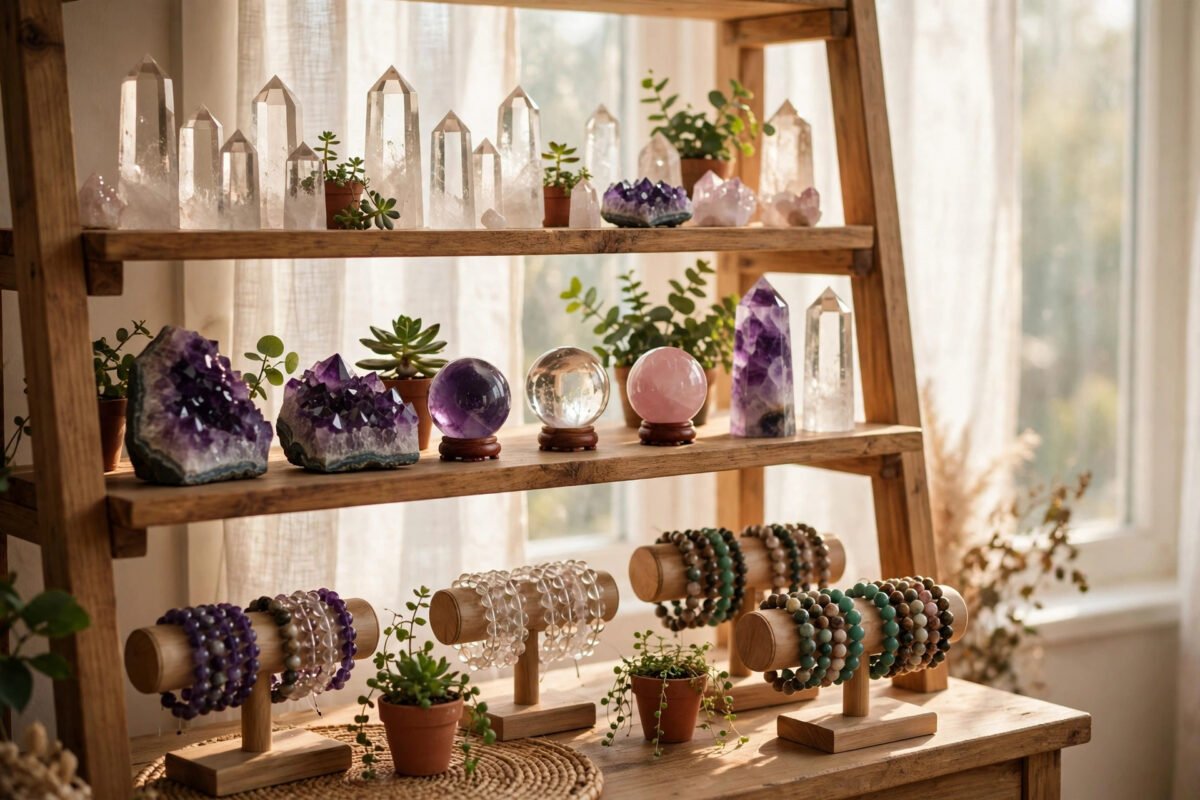
Quality checks for sets mirror those for single points: tips intact, bases flat enough to stand, polish even, and colour similar under the same light. Check the set under daylight and warm indoor light, because some stones shift character between them. Reputable sellers photograph the exact set you will receive rather than a representative one; for characterful alternatives, a set of small phantom and included crystal points makes a grid with real individuality, each satellite carrying its own inner landscape.
Store spare and off-duty points carefully so tips survive until the next layout, using a compartment box as recommended in our guide on how to store crystal bracelets — the same padded separation protects points and bracelets alike.
Building Your First Grid, Step by Step
Start with a surface: a wooden board, a cloth printed with a pattern, a polished crystal slab for a small grid, or simply a clean table. Place the centre stone first and take a moment to state the grid’s purpose plainly, in tradition the step that turns decoration into practice. Then place the inner ring, working in opposite pairs — north and south, east and west — so symmetry builds evenly rather than drifting as you circle.
Add outer rings last, stepping back every few stones to check the pattern from standing height. Finish by “linking” the grid in the traditional way: trace the pattern slowly with a clear quartz point or a fingertip, moving from the centre outward to each stone. Our guide to how to activate a lucky bracelet describes a similar intention-setting approach for wearable pieces, and the same unhurried mindset suits grid building.
Leave the grid undisturbed while it is “working,” dusting around it with a soft brush from your crystal care kit, and dismantle it deliberately when its purpose feels complete. Photographing finished grids is a lovely habit: the photos become a journal of intentions and a library of patterns that worked.
Frequently Asked Questions
How many points do I need for a basic crystal grid?
Six satellite points plus one centre stone make a complete, balanced starter grid in a hexagonal or circular pattern. Four satellites suit a simple cross or square layout. More rings can be added later; a small, well-matched grid always looks better than a large, uneven one.
Should grid points face in or out?
Tradition holds that inward-facing points draw energy toward the centre and its intention, while outward-facing points project energy into the surroundings. Choose based on your purpose, and keep orientation consistent within each ring so the pattern reads clearly.
Can I use tumbled stones instead of points in a grid?
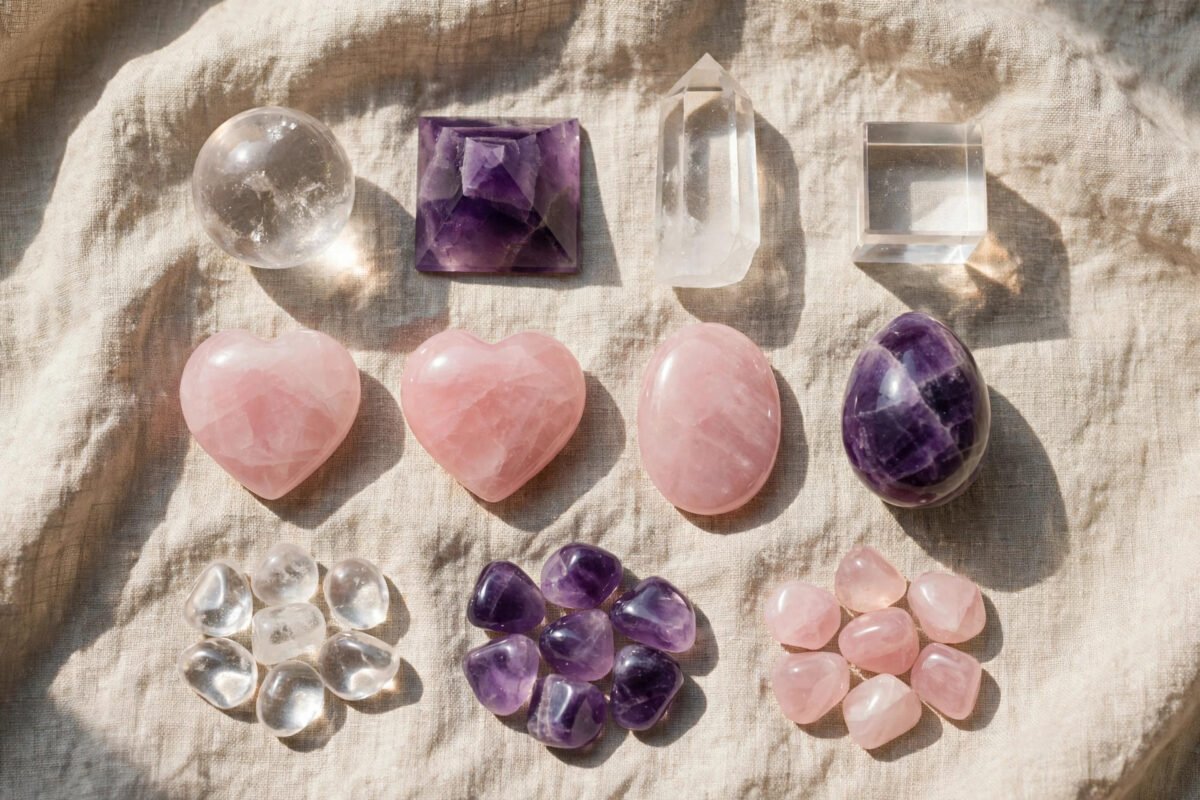
Yes. Many grids use tumbled stones for the outer rings and reserve true points for the centre and inner ring. Points give direction and visual structure; tumbled stones give colour and softness. Mixing the two is standard practice, not a compromise.
What is the best stone for a first grid set?
Clear quartz, because it pairs with everything in tradition and its neutrality keeps patterns visually clean. Add one coloured set — amethyst for calm themes or rose quartz for heart themes — once you know which grids you actually build most often.






 English
 Vietnamese