Breathwork sounds simple until you try it: sit still, breathe slowly, and within ninety seconds your mind is rehearsing tomorrow’s meeting. The missing piece is usually something for your hands to do. A bracelet touchstone solves this — each bead becomes a physical counter for your breath, giving your restless attention a job. This guide shows you exactly how to combine simple breathing practices with your bracelet, no experience required.
Why a Touchstone Makes Breathwork Easier
Beginners struggle with breathwork for one reason: there is nothing to hold onto. Counting breaths in your head competes with the same mental chatter you are trying to quiet. A tactile anchor changes the equation. When your fingers move bead by bead, the counting happens in your hands, and your mind is free to follow the breath itself.
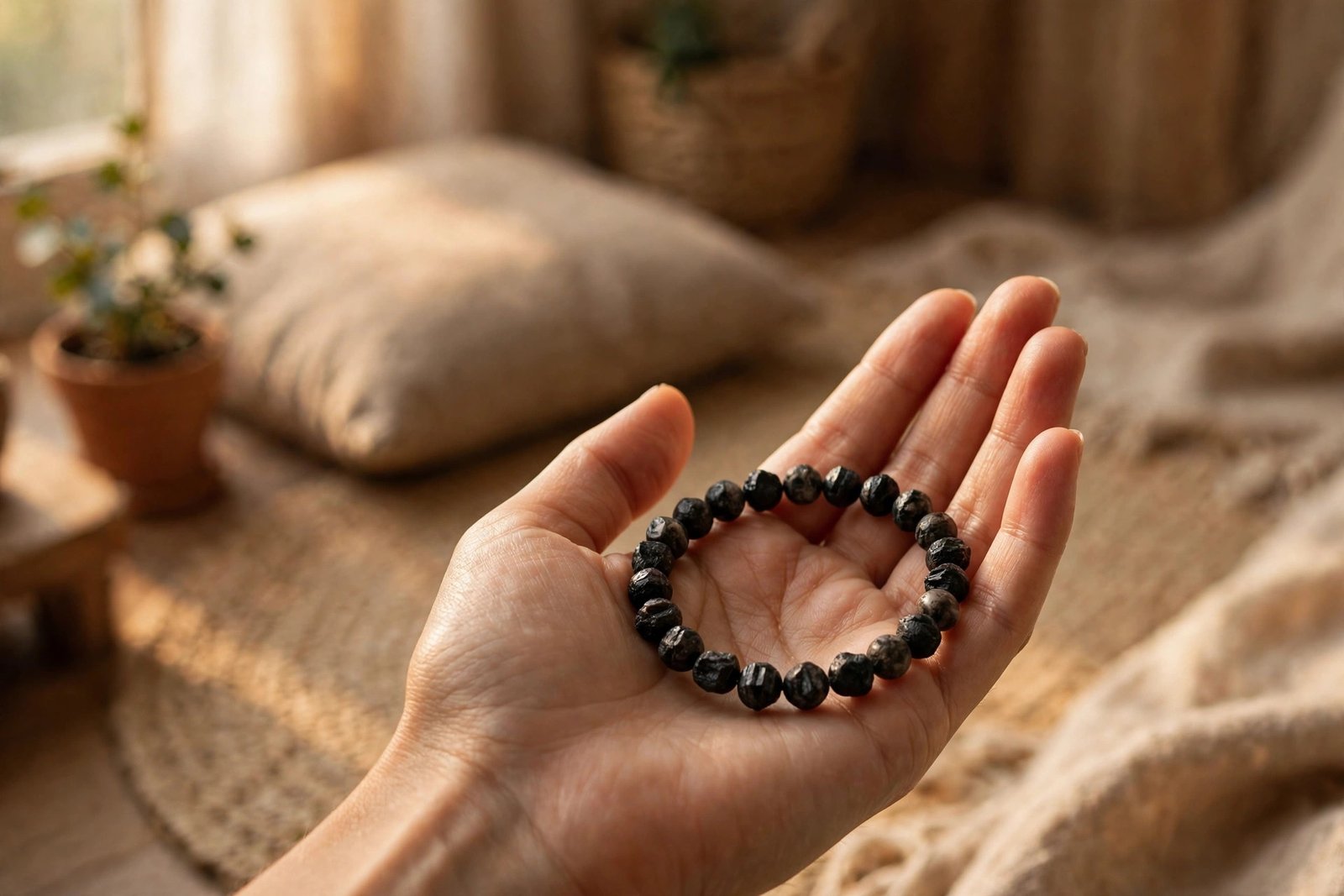
This is not a new idea. The yogic tradition of breath regulation, known as pranayama, has used mala beads as counters for centuries — you can read about the tradition on the pranayama page. Your bracelet is simply a wrist-worn version of the same tool. A grounding crystal bracelet works especially well here: its weight and texture are easy to feel with your eyes closed. Explore more hands-on practices in our mindful rituals collection.
Before You Start: The Setup
- Choose your bracelet. Any beaded bracelet works. Heavier, textured beads are easier to track by touch.
- Sit upright. Chair, floor, or cushion — just keep your spine straight so your lungs have room.
- Slide the bracelet off one wrist and hold it loosely in one hand, or keep it on and touch the beads with the opposite hand. Both work; pick whichever feels natural.
- Set a timer. Five minutes is plenty to start. Knowing the clock is handled lets you stop watching it.
Practice 1: Bead-Count Breathing (5 Minutes)
The foundation practice. Do this one first and return to it whenever the others feel complicated.
- Step 1. Rest your thumb on the first bead. Breathe in slowly through your nose for a count of four.
- Step 2. As you exhale through your mouth for a count of six, slide your thumb to the next bead.
- Step 3. Inhale on the bead, exhale while moving to the next one. One breath cycle per bead.
- Step 4. When you reach the last bead, reverse direction and continue. Keep going until the timer ends.
- Step 5. On the final exhale, hold the bracelet in both palms for three seconds, then open your eyes.
The longer exhale is deliberate: extended exhales are the part of slow breathing most associated with a settling, calming effect. If four and six feel strained, use three and four instead — comfort matters more than the numbers.
Practice 2: Box Breathing with Four Beads (4 Minutes)
Box breathing is a favorite of people who need focus before something demanding — a presentation, a difficult conversation, a deadline sprint.
- Step 1. Place four fingertips (or your thumb) on four consecutive beads.
- Step 2. Inhale for four counts while pressing bead one. Hold for four counts while pressing bead two.
- Step 3. Exhale for four counts while pressing bead three. Hold empty for four counts while pressing bead four.
- Step 4. Repeat the square for four minutes, keeping the pressure on each bead light and even.
The symmetry of the pattern gives a busy mind a tidy structure to follow. Many people find this easier than free-form slow breathing precisely because there is less to decide.
Practice 3: The 3-Breath Reset (90 Seconds)
For moments when you cannot step away — between meetings, in a parked car, at your desk. This is the emergency version.
- Step 1. Touch three beads in a row with your thumb. These are your three breaths.
- Step 2. Breath one: slow inhale through the nose, noticing one thing you can hear. Exhale.
- Step 3. Breath two: slow inhale, noticing one thing you can feel (the chair, your feet, the beads). Exhale.
- Step 4. Breath three: slow inhale, noticing one thing you can see. Long exhale. Done.
Making It a Daily Habit
Attach the practice to a transition you already have: the commute, the lunch break, the moment you sit down at your desk. Five minutes of bead-count breathing before work changes the texture of the whole morning. If anxiety tends to spike at specific times of day, our 5-minute grounding ritual for anxiety was built for exactly those moments, and our inner calm ritual offers a longer seated alternative. Beginners who want a guided seated practice can also try our crystal meditation for beginners.
“The breath is always there, but attention is not. A bracelet does not change your breathing — it changes where your attention goes while you breathe.”
For a dedicated touchstone, the grounding crystal bracelet is the natural pick: substantial beads that are easy to track by touch, traditionally associated with steadiness and presence. If you travel often and want the same practice on the road, the obsidian protection bracelet doubles as a pocket-friendly anchor for unfamiliar places.
Frequently Asked Questions
Can I do breathwork with any bracelet, or does it need to be a specific stone?
Any beaded bracelet works as a touchstone — the mechanism is tactile, not mineral. That said, people tend to stick with the practice longer when the bracelet has personal meaning, which is why grounding stones and stones you already love are the best choice.
How long should each breathwork session be?
Start with five minutes. That is long enough to feel a shift and short enough to do daily. The 90-second reset is for in-the-moment use. Longer sessions of 10–20 minutes are fine once the habit is established, but they are not required to get value from the practice.
What if I lose count of the beads?
Nothing bad happens. Just pick up at whichever bead your thumb is on and keep going. Losing count is actually a sign the practice is working — your attention drifted from counting to breathing, which was the goal all along.
Is breathwork safe for everyone?
Gentle slow breathing like the practices here is a standard mindfulness exercise. If you have a respiratory or cardiovascular condition, or if any breathing pattern makes you dizzy or uncomfortable, stop and check with a healthcare professional before continuing. This is a mindfulness practice, not a treatment.





 English
 Vietnamese