Humidity does not attack crystals the way it attacks leather or paper — quartz itself will not rot. The damage in a humid climate happens around the stone: mould on cords and pouches, rust on metal accents, tarnish, sticky surface film, and fading accelerated by the strong sun that often comes with tropical weather.
If you live in Southeast Asia, a coastal city, or anywhere summers feel like a steam room, a few storage and drying habits will keep an AVENSU bracelet looking new far longer. This guide builds on our detailed piece on crystal bracelet care in a tropical climate.
What Humidity Actually Damages
Start with the organic parts. Elastic and thread stay damp longer, which weakens fibres and lets mildew colonise pouches, cords, and wooden beads. Our wood bead bracelet care guide covers the extra drying wooden elements need in wet seasons.
Metal is next. Iron-bearing findings can rust; plated spacers pit where moisture sits; even sterling silver tarnishes faster in humid, salty air. Hematite and pyrite beads themselves contain iron and can develop rust spots, staining neighbouring pale beads — a risk also noted in can crystal bracelets get wet?.
The stones suffer indirectly. Persistent damp film dulls polish, mineral deposits from hard water spot beads after every rinse, and mouldy storage boxes transfer musty smells and dark specks onto porous stones like turquoise and lava. Background on how moisture drives corrosion and mould growth in household materials is summarised by Britannica’s entry on humidity and standard conservation guidance from museums.
Storage That Works in Wet Climates
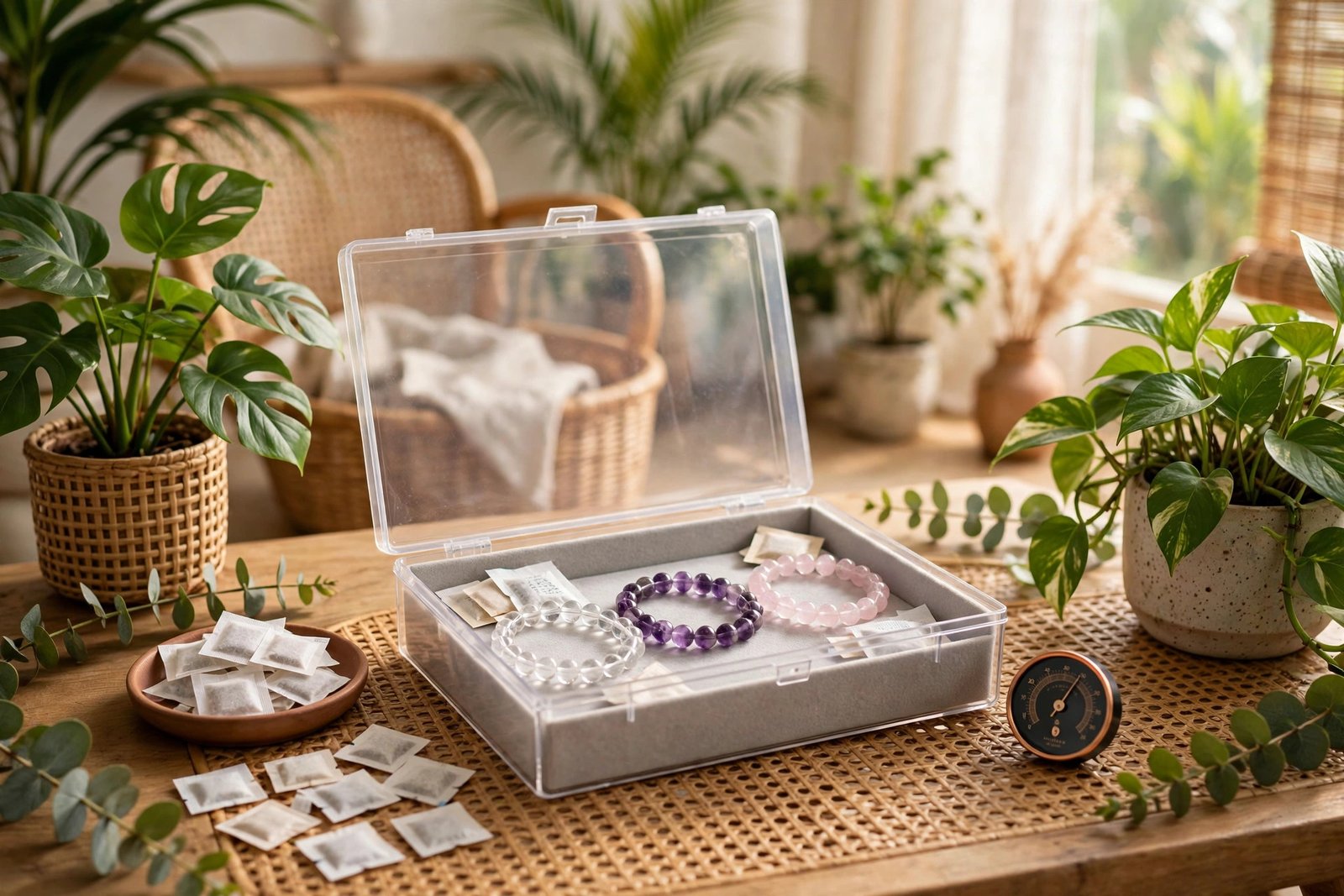
Store bracelets dry, ventilated, and separate. A breathable cotton pouch inside a box with a rechargeable silica gel pack is the classic tropical setup: the pouch prevents scratches, the silica keeps the microclimate dry, and the box blocks light. Replace or recharge silica packs monthly in the wet season — they silently stop working once saturated.
Avoid sealed plastic bags for long-term storage; they trap the very moisture you are trying to escape and are a mould incubator. Avoid bathroom storage entirely, however convenient. A bedroom drawer away from exterior walls (which condense in air-conditioning) is better. Our general guide to how to store crystal bracelets covers drawer layout and separation by hardness — see also storing crystals by hardness.
An AVENSU white jade bracelet shows moisture spotting and film quickly on its pale beads, making it a good early-warning piece: if it looks dull, your storage is too damp.
Drying and Cleaning Routines for Humid Regions
After wearing, wipe each AVENSU bracelet with a dry microfibre cloth before storing — sweat plus humidity is the fastest route to film and tarnish, as our bracelet care after perspiration guide details. Never put a bracelet away damp from rain or washing; air-dry it flat on a cloth for a few hours first.
Wash hard stones as needed with lukewarm water and a drop of mild soap, then dry bead by bead, paying attention to drill holes where water hides. In very hard-water areas, a final wipe with a cloth dampened in distilled water prevents white spots.
Once a month in the wet season, empty your storage box, check pouches for musty smells or spots, sun-dry or replace affected pouches, and inspect metal accents. Our guide to cleaning metal accents shows how to remove early tarnish before it pits. If cloudiness has already set in, work through how to clean cloudy crystals.
Sun, Heat, and Fading in the Tropics
Humid climates usually mean intense sun. Amethyst, rose quartz, citrine, and fluorite are traditionally worn for colour, yet that colour can lighten with prolonged UV exposure — so the sunny windowsill is the worst storage and “charging” spot. Our charging crystals: sunlight vs moonlight guide offers gentler alternatives that respect both tradition and material.
Heat also ages elastic quickly. Keep bracelets out of parked cars and off radiators, and expect to restring daily-wear pieces a little more often in the tropics — the signs to watch for are listed in our elastic cord guide.
For a humidity-resilient daily rotation, browse the AVENSU shop for hard quartz-family pieces with minimal metal, and keep delicate or porous stones for drier indoor days.
Frequently Asked Questions
Can mould grow on crystals themselves?
Mould grows on organic material — cords, pouches, wood beads, and surface grime — rather than on clean quartz. Porous stones can hold mould in surface texture, though. Clean the stone, replace the pouch, and dry the storage box.
Are silica gel packs safe next to crystals?
Yes. Silica gel does not touch-react with gemstones and is widely used in museum storage. Keep packs in the box but not pressed against metal accents, and recharge or replace them regularly or they stop helping.
How do I stop metal spacers rusting in humid air?
Dry the bracelet after every wear, store it with silica gel, and polish accents at the first sign of tarnish. If rust keeps returning, restring the design without iron-based findings or choose an all-stone AVENSU design.
Should I use a dehumidifier for my collection?
For a large collection, a small dry cabinet or a room dehumidifier holding roughly 45–55% relative humidity is ideal. For a few bracelets, a silica-managed box in a bedroom drawer achieves much the same result.



 English
 Vietnamese