Walk into any crystal shop and you will see a forest of towers — some slim and needle-sharp, some broad and architectural, some with six sides and some with four. Two of the most confused shapes are the standing point and the obelisk. They look similar from a distance, yet they are cut differently, stand differently, and are traditionally used for different kinds of focus. Understanding the difference saves you money, prevents wobbly displays, and helps you place each piece where it actually belongs.
This guide breaks down crystal obelisk vs point in plain language: how each is formed, how the facets change the look and feel, which rooms suit each shape, and how to care for tall, top-heavy pieces. If you already wear crystals daily, you will also see how towers pair beautifully with a bracelet from the AVENSU shop for a matched desk or altar setup.
What Is a Standing Point?
A standing point — also sold as a tower or generator point — usually has six sides, echoing the natural hexagonal growth of quartz. According to Mindat.org, quartz crystals naturally grow in a hexagonal prism topped by a pyramid, and cutters simply polish and flatten the base so that form can stand upright on its own.
Key traits of a standing point:
- Six facets on the body in most quartz, amethyst, and fluorite examples, though the count can vary by material.
- A single termination where all sides meet at one apex.
- A wider, more organic feel — even polished points retain a sense of the original crystal.
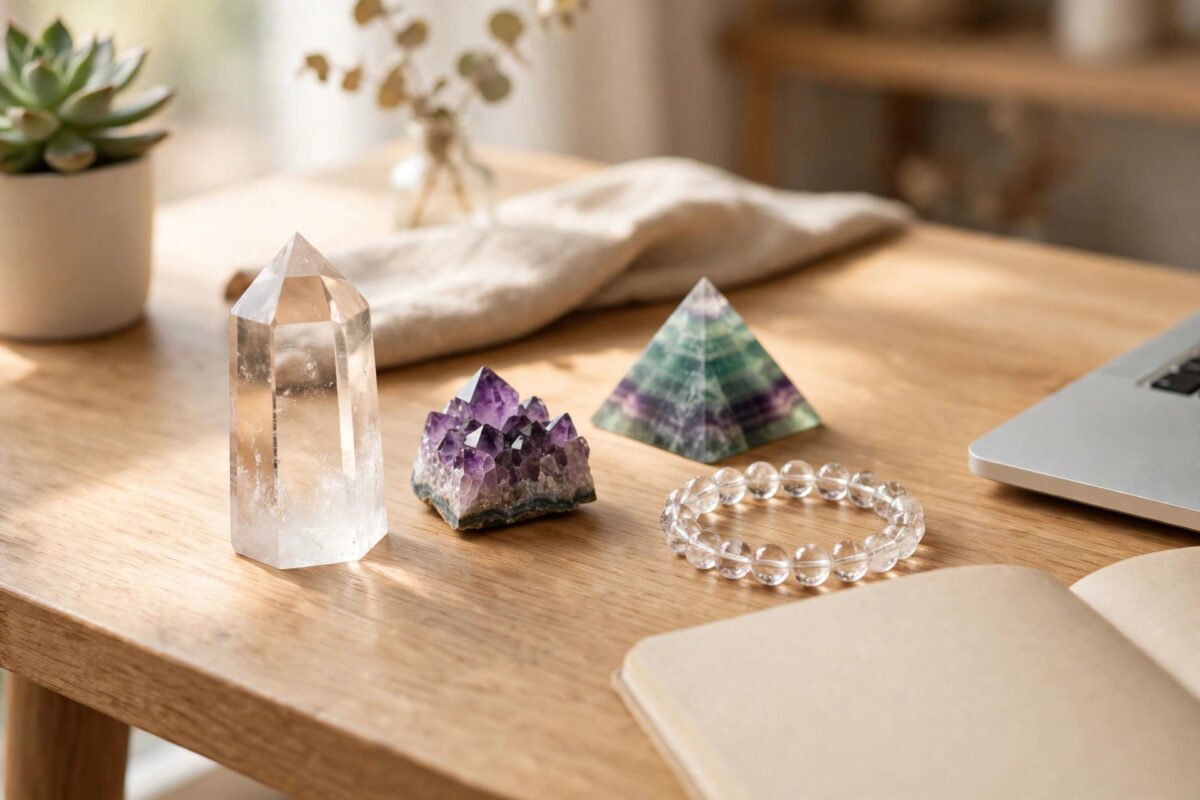
In crystal tradition, a point is believed to gather energy at its base and direct it upward through the tip, which is why points are traditionally associated with focus, clarity, and intention-setting. You can read more about directional stones in our grounding stones meaning guide. Points are a natural centrepiece for a desk: tall enough to notice, compact enough not to dominate.
What Is an Obelisk?
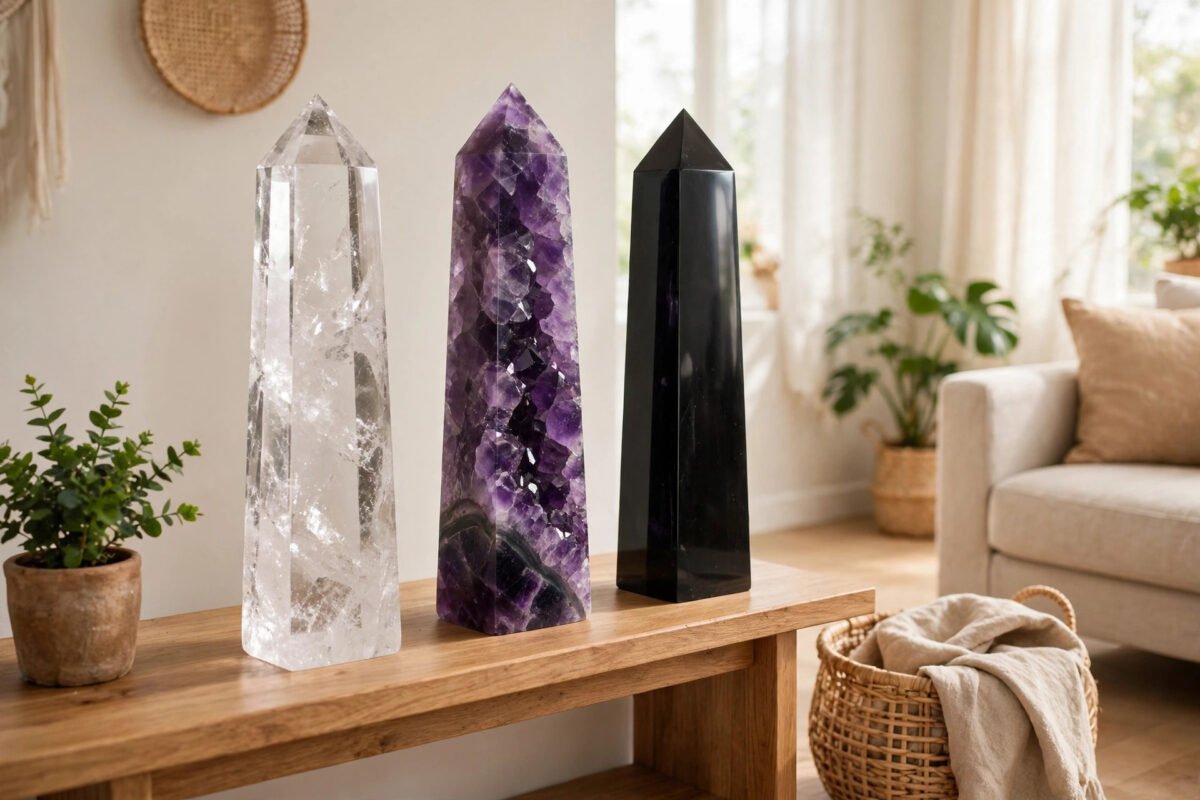
An obelisk is a four-sided tower with a small pyramid top, modelled on ancient Egyptian monuments. Unlike a point, it does not copy natural crystal growth — it is a fully human-designed, architectural form. The four flat faces meet at crisp edges, and the pyramidion at the top is proportionally smaller and sharper than a point’s termination.
Key traits of an obelisk:
- Four sides with clean, straight edges and a distinctly formal silhouette.
- A pyramid cap that concentrates the form into a precise tip.
- Greater visual weight — obelisks read as monuments, so they anchor a shelf or mantel.
Traditionally, the obelisk shape is associated with stability, protection, and structure, because its four sides are linked in folklore to the four directions and four elements. If you enjoy structured rituals, pair an obelisk display with the steps in our full moon luck drawing ritual for a tidy, symmetrical altar layout.
For factual background on historic obelisks, the Encyclopaedia Britannica entry on obelisks is a solid starting point.
Crystal Obelisk vs Point: Side-by-Side Differences
Stability. This is the practical difference most buyers miss. A six-sided point with a broad base is usually self-balancing. A tall, slim obelisk has a narrower footprint relative to its height, so it can tip more easily on an uneven shelf. Our guide to displaying large crystals safely covers museum putty, stands, and placement away from foot traffic — read it before buying anything over 20 cm tall.
Light play. Six facets scatter light in more directions, giving points a lively sparkle. Four broad faces on an obelisk create larger, calmer reflections — beautiful in banded stones like agate or jasper where you want to see the pattern, less dramatic in clear quartz.
Price and material use. Obelisks require more cutting to achieve perfect symmetry, so matched four-sided pieces can cost more per gram. Points that follow natural growth waste less material.
Which rooms suit which? Choose points for desks, meditation corners, and bedside tables where focused, upward energy is traditionally desired. Choose obelisks for entryways, living-room shelves, and workspaces where you want a grounded, architectural anchor. Our comparison of spheres vs towers as centrepieces expands on room-by-room placement.
Whatever you choose, store smaller companion pieces properly using the tips in how to store crystal bracelets so towers and jewellery do not chip each other.
How to Choose and Care for Tall Pieces
Measure first. Note the height and base width, check that your shelf depth exceeds the base by at least 2 cm on each side, and keep tall pieces away from door swings and curious pets. Dust weekly with a dry microfibre cloth; wash only stones that tolerate water, and check our complete crystal bracelet care routine for hardness-based cleaning rules that apply to towers too.
If you love the focused look of a point but want something wearable, a pointed-bead or tower-charm bracelet from the AVENSU shop gives you the same silhouette in miniature. Many collectors also keep a grounding crystal bracelet on the desk beside a tower as a tactile reminder of their intention during work.
Finally, verify authenticity before paying tower prices. The tests in how to tell if a crystal is real — temperature, inclusions, and hardness — apply just as well to large display pieces as they do to beads.
Frequently Asked Questions
Is an obelisk stronger or more powerful than a point?
Neither shape is objectively more powerful. In tradition, points are believed to direct energy in a focused beam, while obelisks are believed to radiate steadiness from four sides. Choose based on your space, stability needs, and which silhouette you enjoy looking at every day.
Can I use an obelisk and a point together?
Yes — collectors often do. Place the point where you want focus, such as a desk, and the obelisk where you want an anchor, such as an entry shelf. Keep a small gap between pieces so edges do not chip, and avoid stacking towers on top of each other.
Why does my tall point wobble?
Most wobbles come from a slightly uneven cut base or an unlevel shelf. Try rotating the piece a quarter turn, placing it on a flat slate coaster, or adding a pea-sized dot of removable museum putty under the base. Never sand the base yourself — it reduces value and can crack the stone.
Which shape is better for beginners?
A medium standing point, around 8–12 cm tall with a wide base, is the most forgiving first tower. It is stable, affordable in quartz or amethyst, and easy to clean. Add an obelisk later when you know exactly which shelf it will live on.











 English
 Vietnamese