Yoga and the chakra system grew up together in Indian contemplative tradition, so it is no surprise that practitioners pair them. In that tradition, certain poses are associated with certain energy centers, and a crystal placed at the corner of the mat, held in a palm, or worn as a bracelet is believed to help hold attention on that center through the practice. The stone is a focus object. The breath and the movement still do the real work.
This guide shows which crystals people traditionally pair with each part of a practice, how to use them safely on the mat, and how to carry the same focus into the rest of the day. For the background system itself, see our guide to chakra balancing for beginners.
Matching Crystals to Your Practice
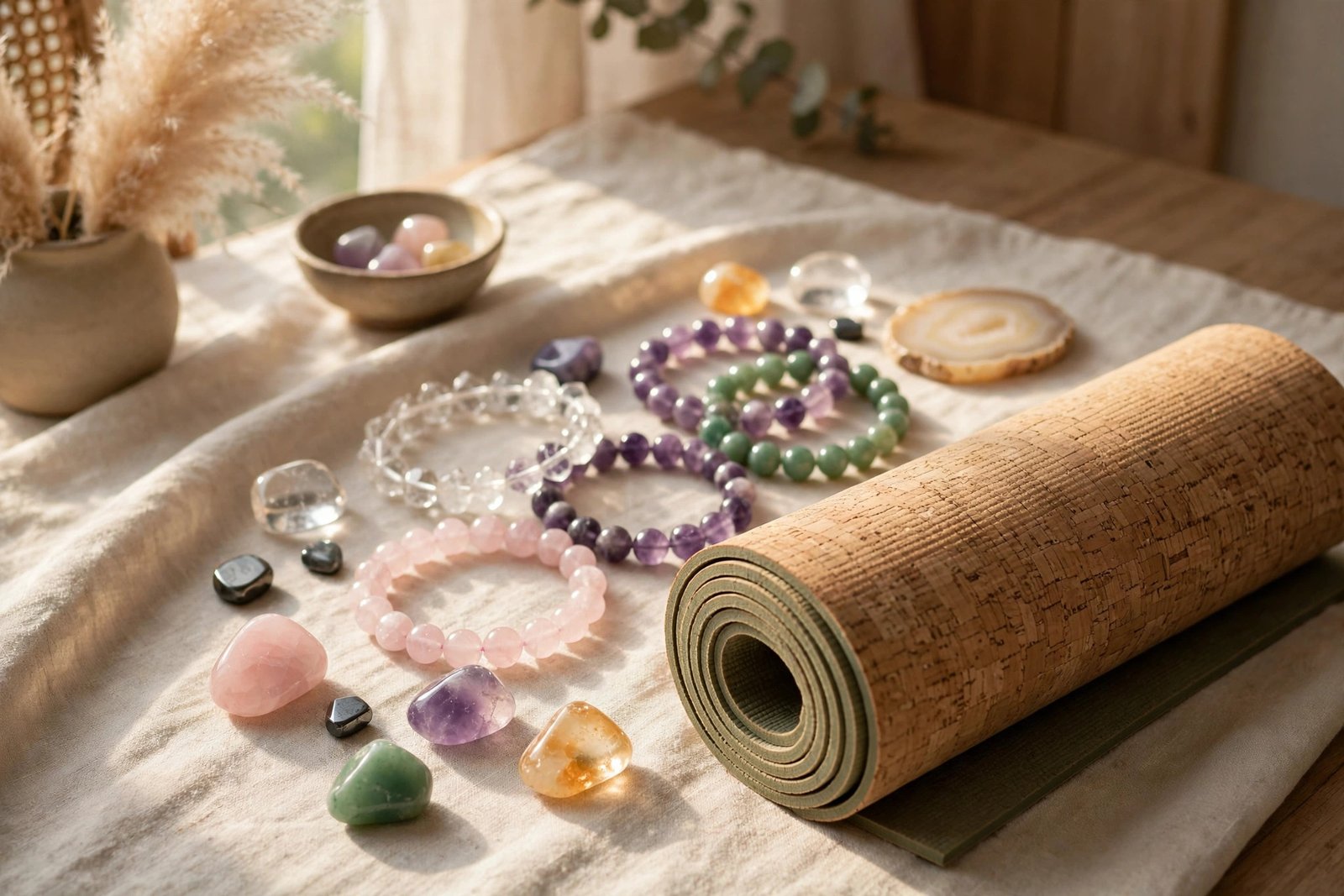
For grounding sequences built on standing poses and forward folds, root chakra stones such as red jasper, hematite, and smoky quartz are the traditional choice. Our root chakra crystals guide lists the main options. Place a tumbled stone at the top corners of your mat where you can see it in standing poses.
Flowing sequences and hip openers are traditionally linked with the sacral chakra, paired with carnelian and orange calcite. For heart-opening backbends, rose quartz and green aventurine are the classic companions; our heart chakra stones guide explains both stones in detail. Core work pairs traditionally with citrine and tiger’s eye for the solar plexus.
For meditation and savasana, amethyst and clear quartz are most common. Our amethyst meaning guide covers why amethyst has been associated with calm focus for centuries. A single stone resting on the mat above your head, or held loosely in one hand, is enough. Anything more becomes clutter you have to manage instead of a practice you can sink into.
On the Mat: Placement That Actually Works
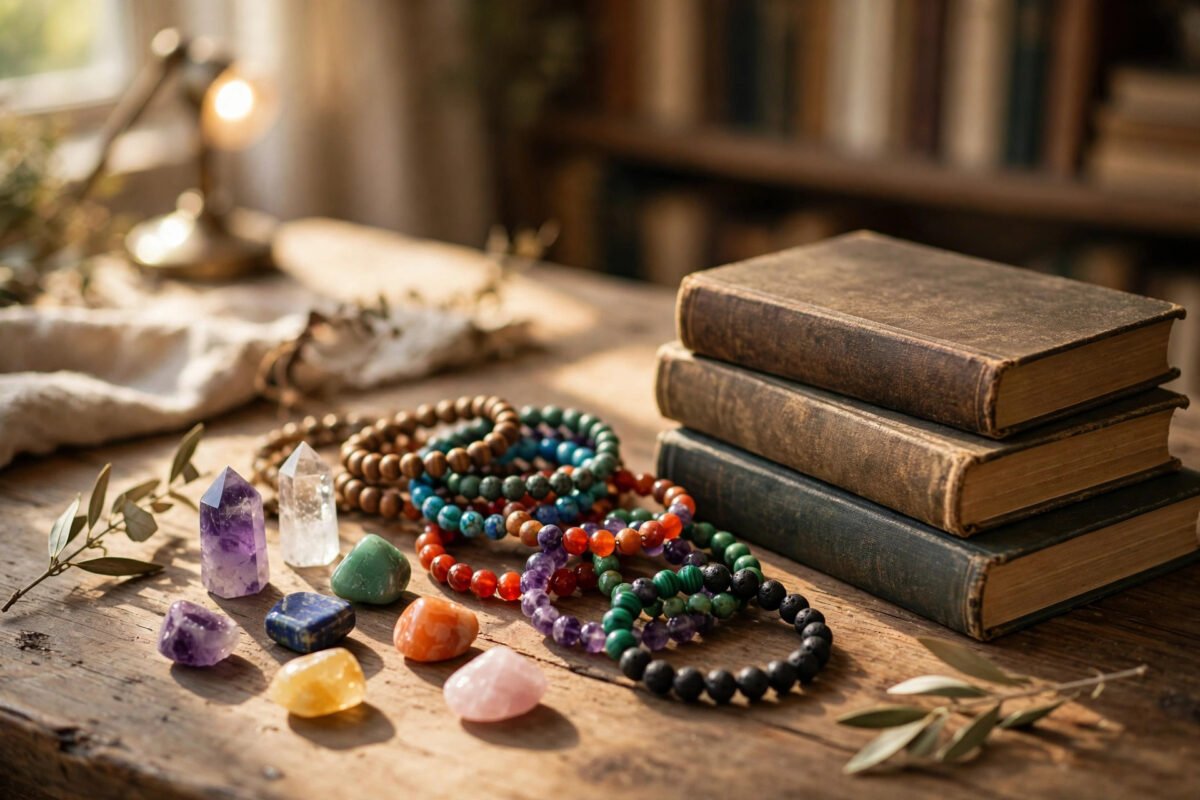
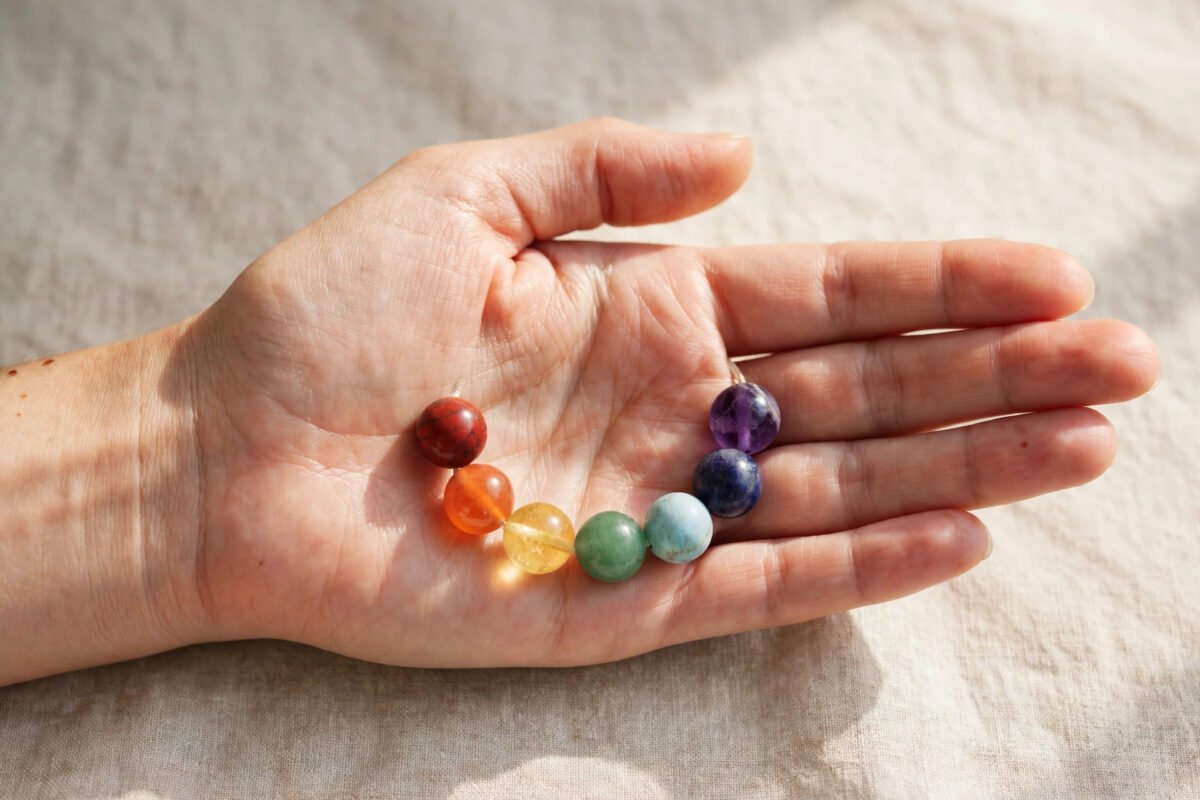
Loose stones roll, and rolling stones end practices early. Keep crystals at the mat’s corners, on a small tray beside you, or worn on the body. A bracelet is the most practical option for flowing practice because it moves with you. An AVENSU chakra bracelet stays put through sun salutations in a way a pocketed stone never will, and the beads give your thumb something to find in seated meditation.
Be honest about which poses rule stones out. Wrist weight-bearing poses such as plank and downward dog are uncomfortable with chunky bracelets for some people, and prone poses make necklaces swing and press. Slide a bracelet higher on the forearm for floor work, or take it off and place it at the mat’s edge as your visual anchor. Neither choice breaks the practice. Comfort protects your joints; the stone is optional equipment.
Hot and vigorous classes deserve extra caution. Sweat makes elastic slippery and skin more sensitive, and heated rooms are hard on some stones and cords. Many practitioners keep a simple, sturdy practice bracelet for class and save delicate pieces for home. Rinse sweat off beads after class and dry them flat, the same care you would give any piece from the AVENSU shop.
Off the Mat: Carrying the Practice into the Day
The point of pairing crystals with yoga is not the forty-five minutes on the mat. It is the hour after class when traffic, email, and other people test whatever calm you built. Wearing your practice bracelet through the day is the simplest bridge: the same beads you held in savasana are on your wrist in the meeting. Our crystal meditation guide for beginners uses the same principle for seated practice.
Build one small off-mat ritual per chakra focus. Root week: stand barefoot for a minute before your first coffee. Heart week: keep the rose quartz bracelet on the wrist you write with, so you see it when you type difficult messages. Throat week: a breath and a bead-roll before you speak in a meeting. These micro-habits are where a tradition becomes a personal practice.
An AVENSU bracelet worn daily will pick up sweat, lotion, and dust, so give it a gentle cleanse weekly. Sound is a good sweat-safe option; see how to cleanse crystals with sound. For historical context on yoga’s development, the Britannica entry on yoga is a solid starting point.
Frequently Asked Questions
Can I wear a crystal bracelet during yoga?
Yes, most people can, especially in gentle, yin, and seated practices. For wrist-heavy flows, slide the bracelet up the forearm or set it at the edge of the mat. If a bracelet ever pinches, digs in during prone poses, or distracts you, take it off. The practice matters more than the accessory.
Which crystal is best for savasana and meditation?
Amethyst and clear quartz are the traditional favourites for the still end of practice, associated with the third eye and crown chakras. Hold one stone loosely or rest it on the mat above your head. Avoid placing stones on the forehead until you know you lie completely still.
Where should I put loose stones so they do not roll away?
Use the top corners of the mat, a small flat dish beside the mat, or a folded towel as a tray. Never scatter loose stones across the floor of a shared studio, where someone else can step on them in bare feet.
How do I choose one chakra to focus a whole class on?
Pick the center that matches the class theme: grounding flows for root, hip openers for sacral, backbends for heart, twists and core for solar plexus. Wear or place only that center’s stone. One focus per class keeps the pairing meaningful instead of decorative.







 English
 Vietnamese