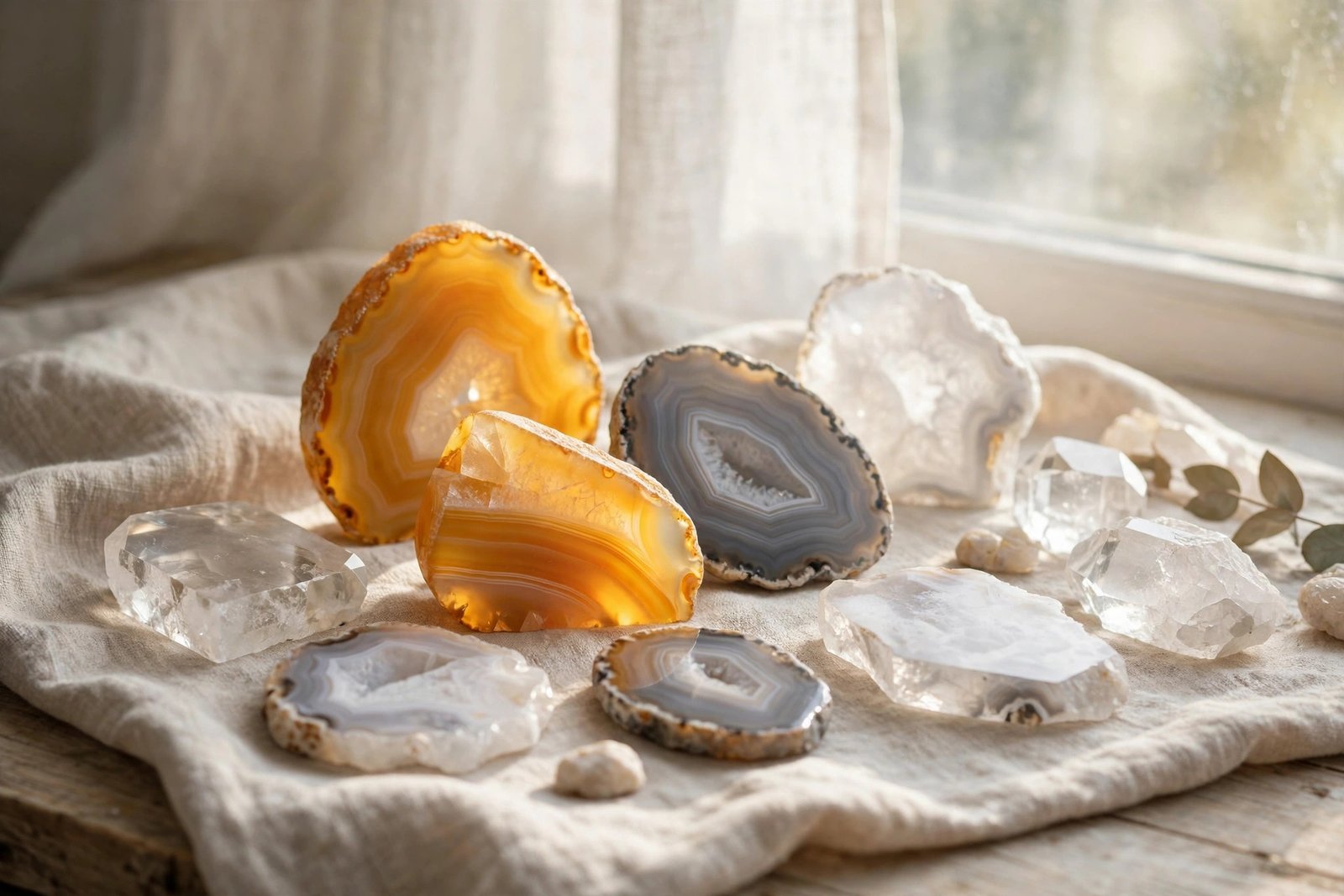
Hold a thin slice of agate up to a window and it glows: bands of amber, grey and white turn translucent, and patterns hidden in the solid stone suddenly appear. Polished slabs and slices are crystal cut flat rather than round or pointed, and they reveal a side of stone that beads and towers cannot — the internal landscape, laid out like a map. From luminous agate windows to practical crystal coasters, these flat forms have quietly become some of the most versatile pieces in a collection.
This guide explains how slabs and slices are cut, how to judge their quality, and the many ways people use them at home.
How Slabs and Slices Are Cut and Polished
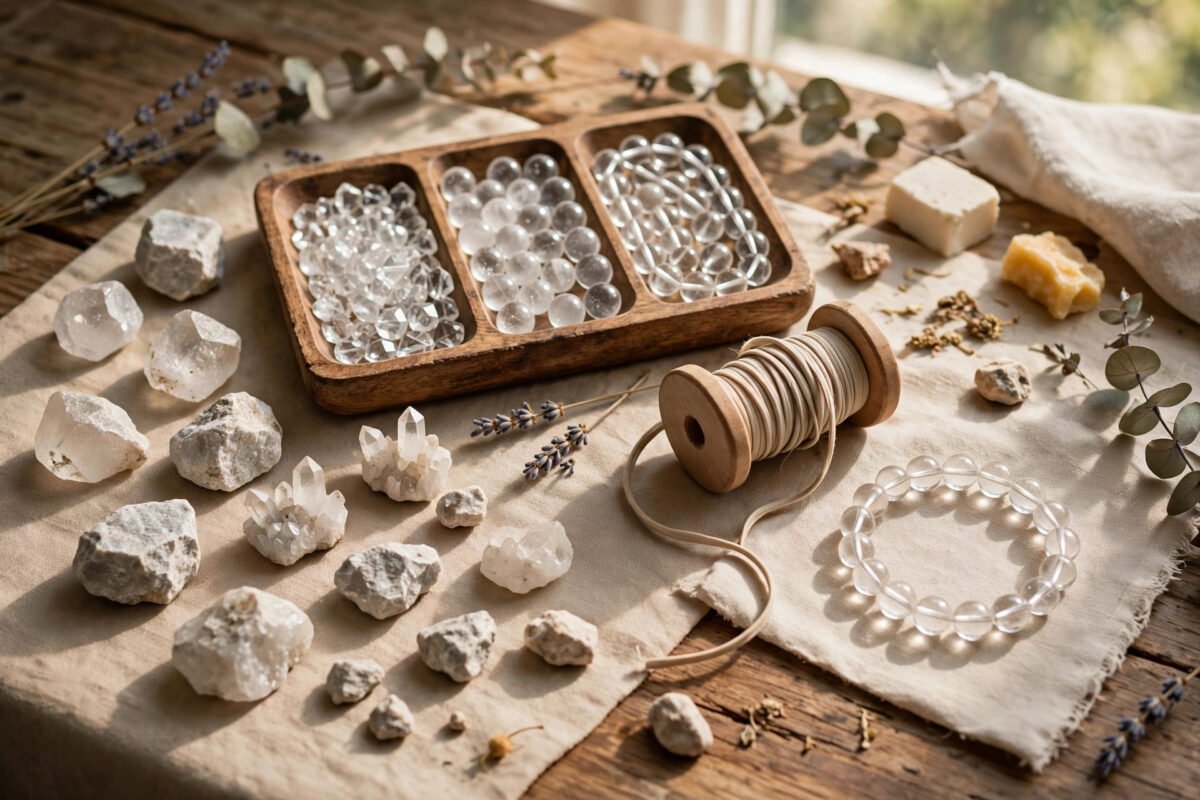
Slabbing starts with a large saw. Rough boulders or geodes are sliced with a water-cooled diamond blade into even sections, typically a few millimetres thick for translucent slices and thicker for standing slabs. The cutter reads the rough first, orienting the cut to show the best banding or pattern, much as bead makers plan their cuts in our guide to how crystal beads are made.
Agate is the star material because it is a translucent, banded form of chalcedony; its layers formed as silica-rich water deposited mineral bands inside rock cavities over long geological periods, a process summarised in the Wikipedia article on agate. Sliced thin, those bands become the flowing lines collectors love. Other popular slab stones include labradorite for flash, jasper for landscape-like pictures, petrified wood for visible grain, and amethyst for purple crystal edges on a flat plate.
After sawing, each slice is ground flat and polished through progressively finer abrasives until the faces turn glossy. Edges may be left natural, polished smooth, or — in the case of coasters — given a metallic painted rim. Quality pieces are flat, evenly thick and free of saw marks, those faint curved lines a rushed polish leaves behind.
Judging Quality: Light, Flatness and Edges
Backlighting is the collector’s first test. Hold the slice toward a window or place it on a phone torch: good agate shows even translucency and clear banding, while muddy or opaque patches suggest thicker, less carefully chosen material. Colour should look natural; very bright neon blues and pinks are usually dyed, which is not a flaw if disclosed, but dyed slices should cost less than natural ones.
Run a fingertip across the face. A quality polish feels uniformly smooth, with no gritty patches or sticky resin spots. Check the edges for chips, especially on thin slices, and lay the piece on a flat table to confirm it does not rock — warping happens when slices are cut too thin for their size. For display slabs meant to stand, thickness and a properly flattened base edge matter more than translucency.
If you collect other flat-based forms, the same flatness check applies to the bases of generator crystal points and the agate bases under crystal gem trees, which are often slices put to structural work.
Ways to Use Slabs and Slices at Home
The agate window is the signature use: a slice propped on a small stand in front of a window or lamp, where backlight turns it into natural stained glass. Thin slices also become coasters — agate, quartz and marble-effect crystal coasters protect tables while showing off banding — though hot mugs and condensation make coasters working pieces, so expect gradual wear and use felt pads beneath them.
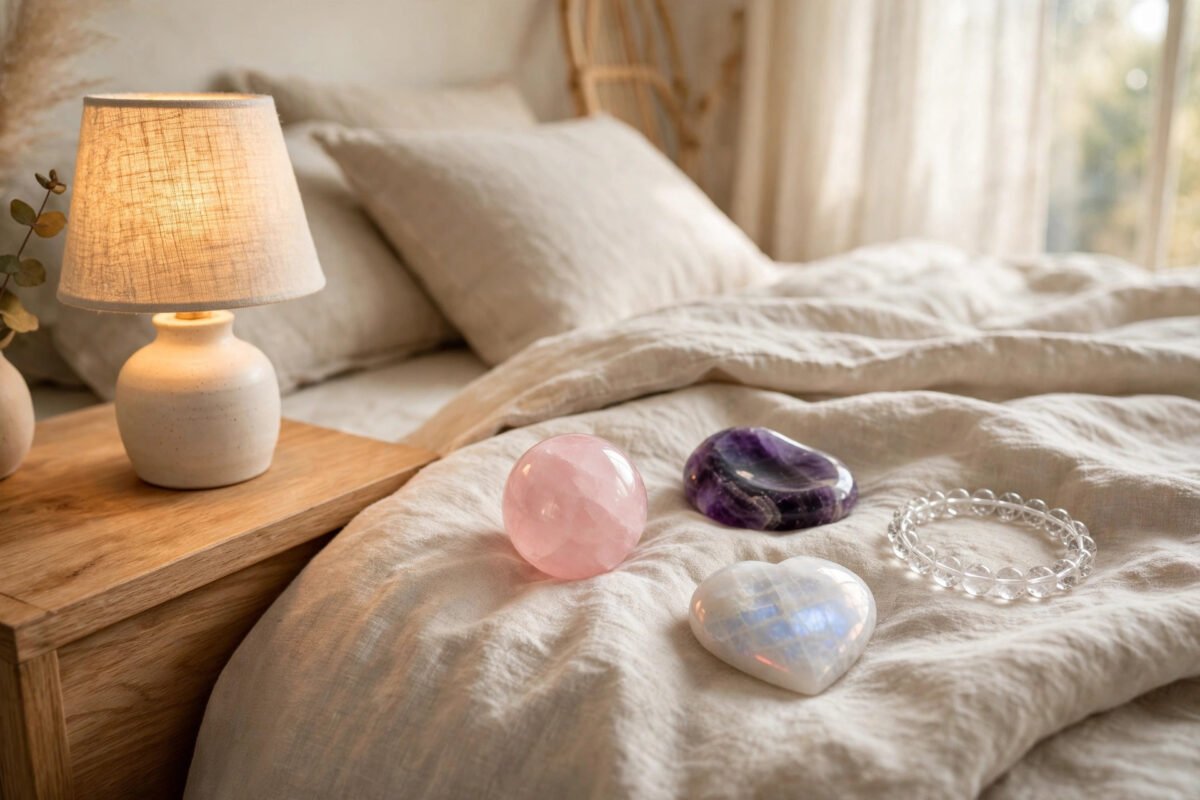
Flat slabs make elegant charging and display plates in crystal practice: bracelets and small pieces are rested on a slab overnight, a tradition often linked with selenite plates and clear quartz. An AVENSU bracelet laid on an agate slice beside the bed is both a tidy habit and an attractive one, and it keeps pieces separated, in line with our guide on how to store crystal bracelets. Browse wearable pieces to rest on your slab in the AVENSU shop.
Beyond ritual uses, slices serve as trinket dishes for rings, as cheese and serving boards in food-safe stones such as quartz and marble (seal porous stone and wash promptly), as bookends in thick pairs, and as photography backdrops — their natural pattern flatters jewellery product shots, which is why so many crystal shops photograph bracelets on agate.
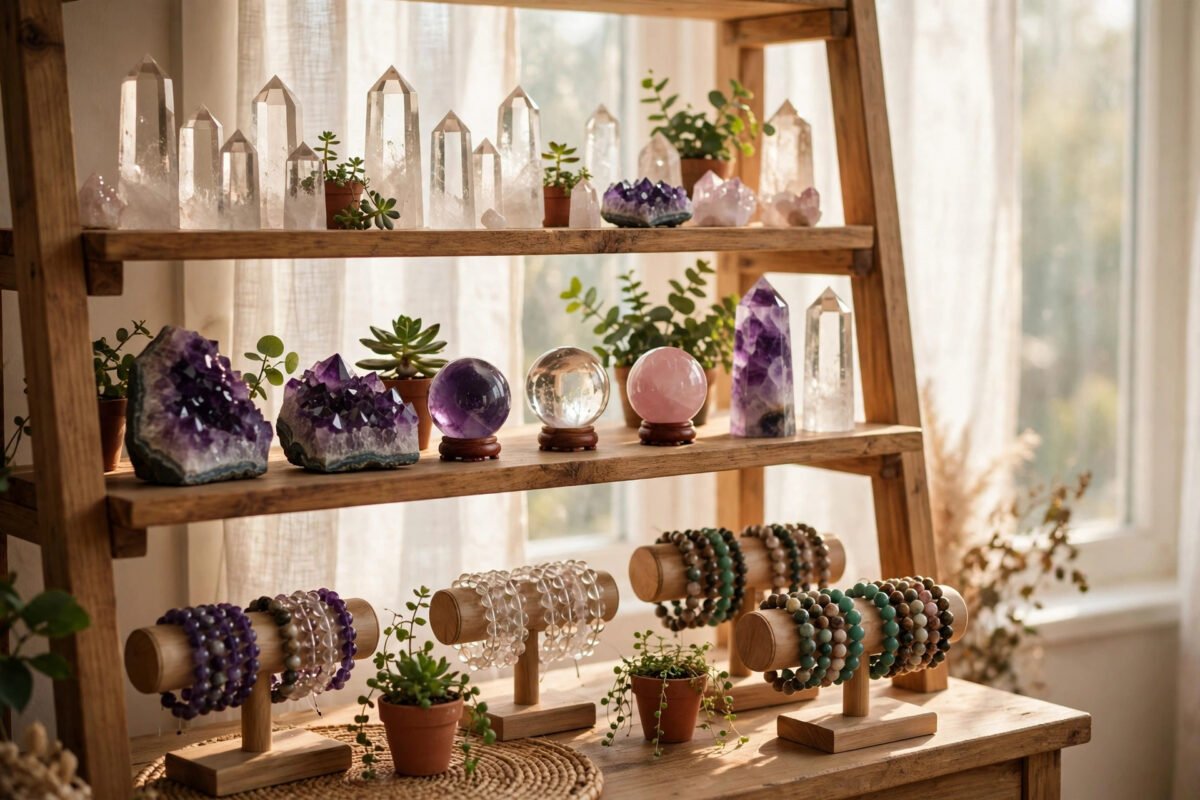
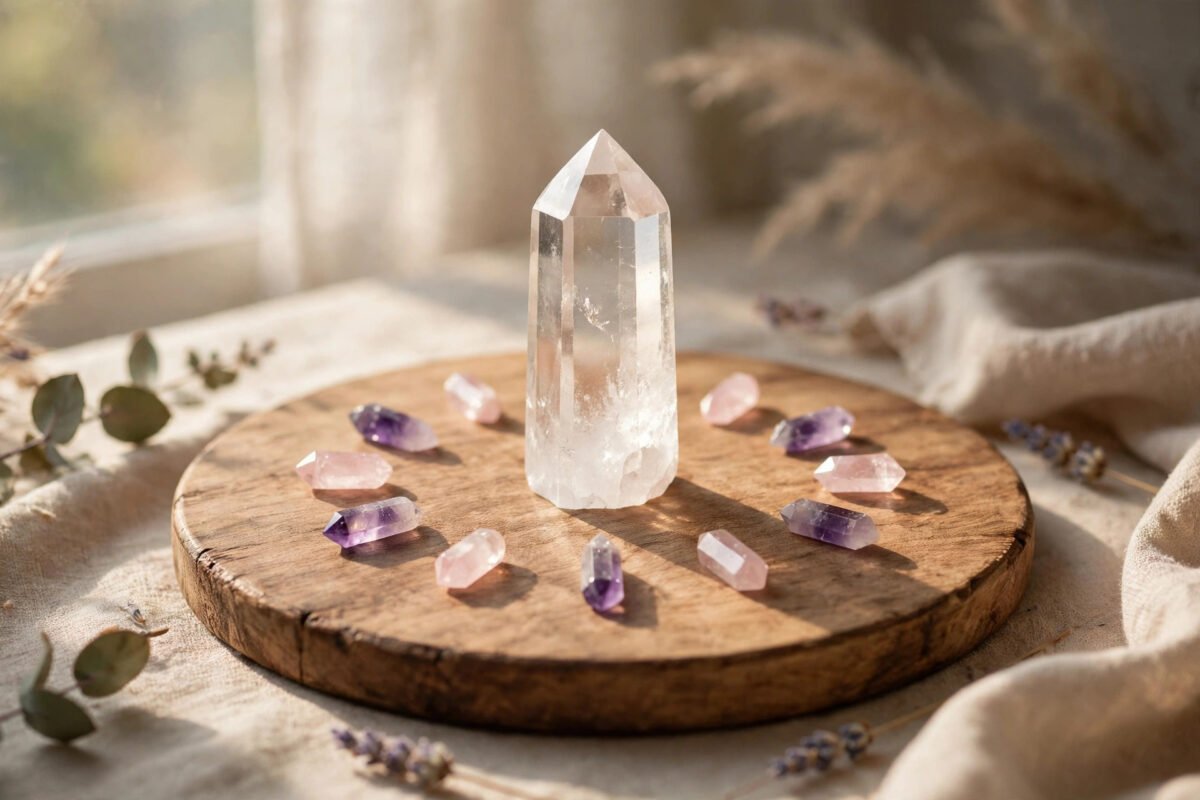
Collectors building a wider display often combine forms: a slab as the base layer, a mini crystal collection arranged on top, and one taller point behind for height.
Care: Keeping the Polish and Preventing Cracks
Slabs are sturdy but not invincible. Thin slices crack if dropped on hard floors or shocked by sudden temperature changes, so avoid placing a cold slice under a very hot dish. Clean with warm water, mild soap and a soft cloth; dry promptly to prevent water spots on the polish. The brushes and cloths listed in our crystal care kit essentials suit slab care well.
Store slices upright in a rack or separated by felt or card in a drawer, since face-to-face stacking scratches polish over time. Keep dyed slices out of prolonged strong sunlight, which can fade the dye unevenly, and keep selenite slabs dry — selenite is soft and water-sensitive, so wipe it with a dry cloth only. Coasters with metallic rims should be hand-washed and dried to protect the edging. With that modest care, a good slab keeps its glow for decades and often becomes the base layer of every display its owner builds, sitting comfortably alongside newer phantom and included crystals and other specimen pieces.
Frequently Asked Questions
What is the difference between a slab and a slice?
The words overlap, but sellers usually use slice for a thin, often translucent section meant to be backlit or used as a coaster, and slab for a thicker, sturdier piece that can stand, serve as a plate or support other objects. Thickness and intended use, not the stone, make the distinction.
Are dyed agate slices real crystal?
The stone is real agate, but its colour has been enhanced with dye that settles into the stone’s more porous bands. Dyed slices are a long-standing, legitimate product when the dyeing is disclosed. They should be priced below comparable natural-colour material and may fade in strong sun.
Can I use a crystal slab as a coaster for hot drinks?
Hard stones such as agate and quartz handle warmth well, but sudden extremes can crack thin slices, and condensation rings can mark polish over time. Use slices of at least moderate thickness, add felt pads underneath, and let very hot mugs cool slightly first. Expect coasters to age gracefully rather than stay perfect.
How thick should a display slice be?
For backlit window display, roughly 3–6 mm shows colour and translucency best. For coasters and plates that will carry weight, choose 8 mm or more. Very large thin slices are fragile, so as diameter grows, thickness should grow with it.



 English
 Vietnamese