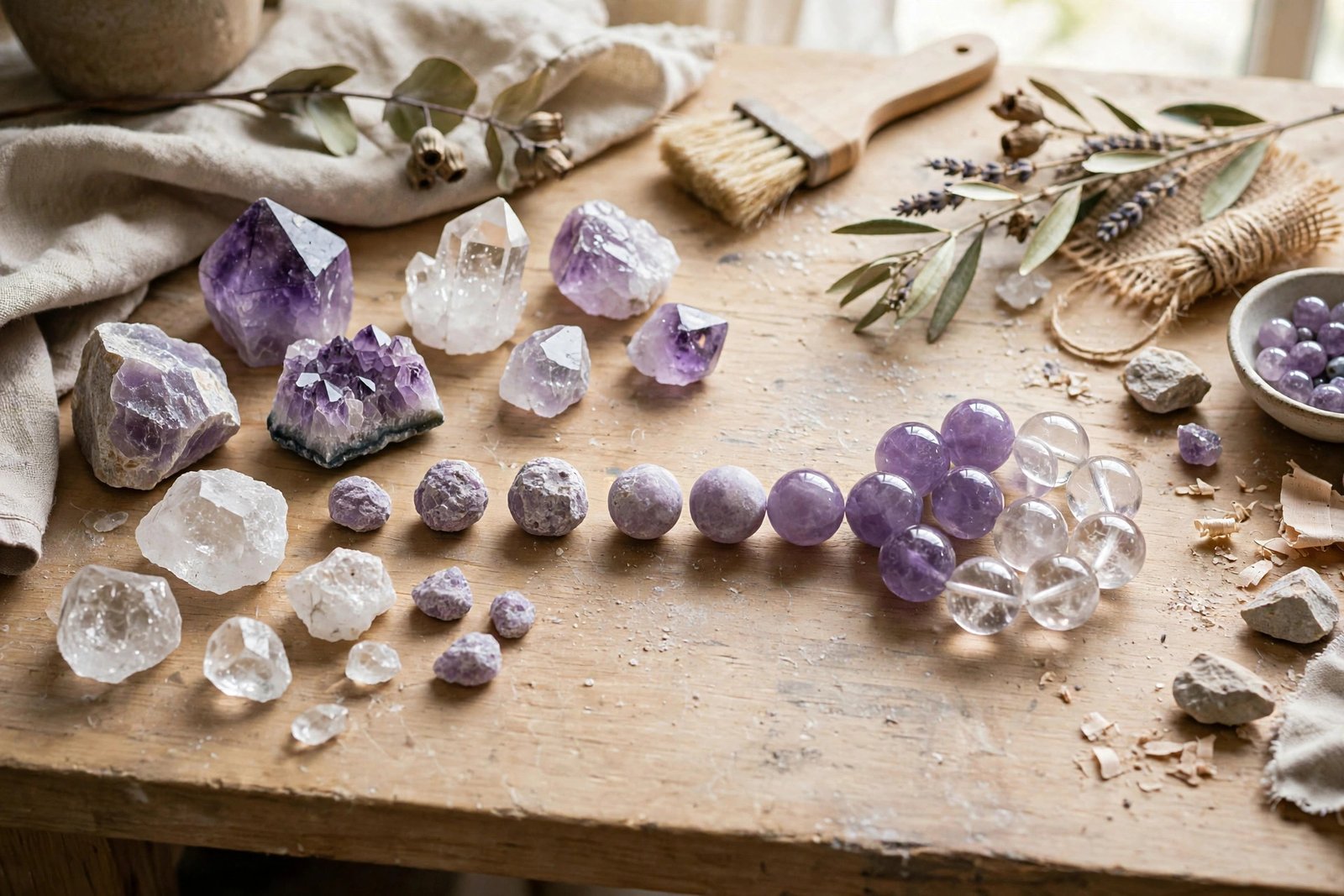
Every smooth crystal bead started life as a rough, irregular chunk of stone. The journey from that rough material to a glossy, perfectly round bead involves cutting, grinding, drilling and hours of polishing, and each stage decides whether the finished bead glows or looks dull. Understanding how crystal beads are made helps you judge quality at a glance, spot a well-finished bracelet, and appreciate why two bracelets in the same stone can look and feel so different.
This guide walks through each stage of bead making, the shapes cutters produce along the way, and the quality checks worth doing before you buy.
Stage One: Selecting and Sawing the Rough
Bead making begins at the mine or the rough dealer’s yard, where cutters sort raw crystal by colour, clarity and freedom from fractures. Only a fraction of mined material is suitable for beads: heavily cracked or cloudy rough is set aside for chips, tumbled stones or carving, while clean, evenly coloured pieces are reserved for round beads. You can read about how quartz and other minerals form and are classified on Wikipedia’s mineral overview.
The selected rough is then sawn into smaller blocks with diamond-edged blades cooled by water. Cutters plan these cuts carefully, reading the stone’s colour zoning and internal fractures so that each block yields the largest possible beads with the fewest flaws. A poorly planned saw cut can waste a third of the material, which is one reason fine, large beads cost noticeably more than small ones.
From the sawn blocks, workers trim cubes or rough spheres on a grinding wheel. At this stage the future bead is only a dull, faceted approximation of round, often called a preform. Sorting happens again here: preforms with visible cracks are removed before more time is spent on them.
Stage Two: Shaping, Drilling and the First Polish
Preforms are shaped in batches. In traditional workshops, beads are ground against a rotating stone or in a tumbling barrel with abrasive grit, gradually rounding them until they match a target diameter such as 6 mm, 8 mm or 10 mm. Modern factories use calibrated machines, but the principle is the same: remove material evenly until the bead is spherical and consistent with its neighbours. Our bracelet bead size guide explains how those finished sizes look and feel on the wrist.
Drilling is the most delicate step. Each bead needs a clean hole through its centre, drilled with a fine diamond or ultrasonic drill, often from both sides to meet in the middle and avoid chipping the exit point. Off-centre or rough-edged holes are a common flaw in cheap beads: they make a bracelet sit unevenly and can fray the elastic cord over time, which is why our complete crystal bracelet care routine recommends checking drill holes when a bracelet starts to feel loose.
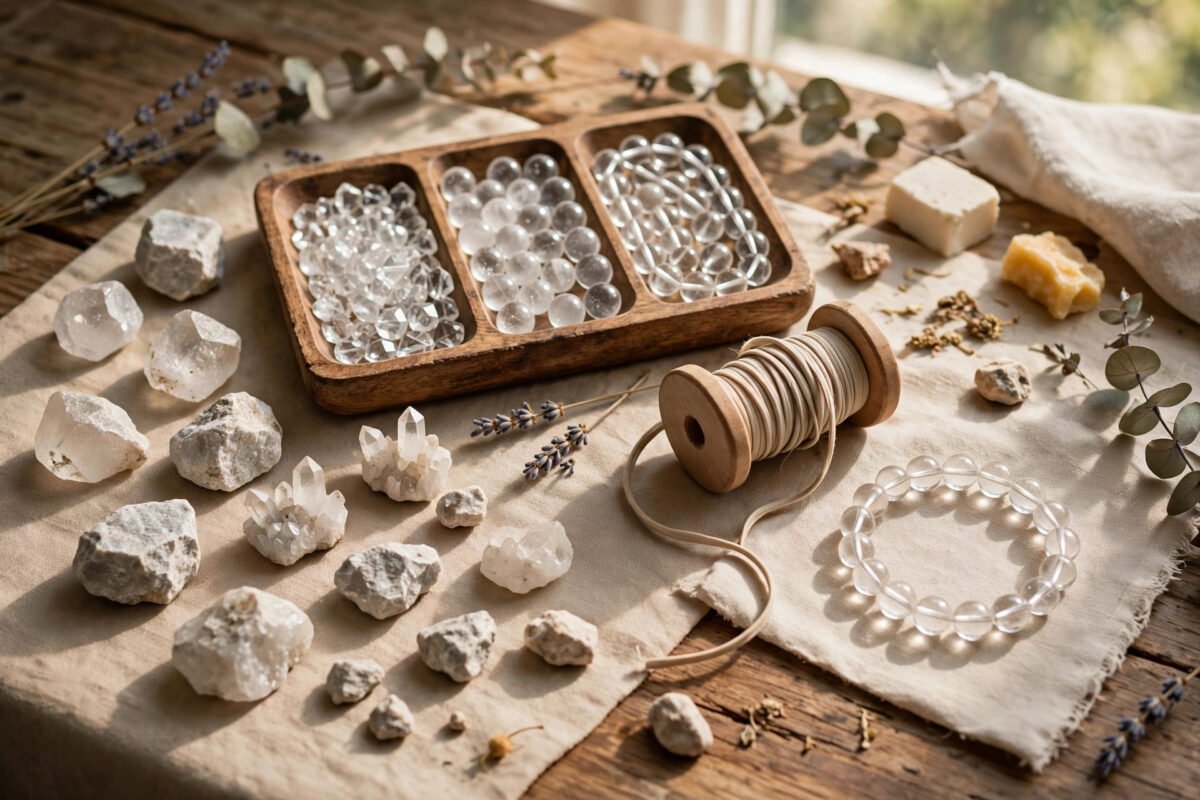
After drilling, beads go through progressive polishing, moving from coarse grits to fine powders until the surface turns glossy. Some stones, such as matte-finish lava or frosted quartz, stop earlier by design. Final quality control sorts beads by size, colour match and surface finish, because a bracelet looks best when every bead in the strand is closely matched.
Beyond Round: The Main Bead Shapes Cutters Make
Round beads dominate bracelets because they roll comfortably against the skin and show colour evenly, but cutters produce several other shapes from the same rough. Faceted beads are ground with flat, angled faces that catch light with every movement, popular in clear quartz, amethyst and smoky quartz. Rondelle beads are flattened discs, often used as spacers. Barrel and tube beads give a modern, structured look, while freeform nuggets keep some of the stone’s natural character.
Faceting takes considerably longer than simple rounding, which is why faceted bracelets usually cost more. The angles must be consistent or the sparkle looks chaotic rather than bright. For background on how gem cutting developed as a craft, the Gemological Institute of America (GIA) offers an accessible introduction to cutting styles and why they matter.
Shape also affects meaning in tradition. Round beads are traditionally associated with wholeness and smooth-flowing energy, while faceted beads are believed to amplify and scatter light more actively. Whichever you prefer, an AVENSU crystal bracelet uses closely matched beads in your chosen shape so the strand looks intentional rather than assembled from leftovers. Browse current styles in the AVENSU shop.
How to Judge Bead Quality Before You Buy
A few simple checks separate well-made beads from poor ones. First, roll the bracelet gently on a flat surface: beads should be evenly round and the strand should roll smoothly rather than wobbling around oversized or misshapen pieces. Second, look at the drill holes. Clean, centred holes with no white chipping indicate careful work and protect the cord. Third, compare colour and clarity across the strand. Slight natural variation is normal and even desirable, but one dramatically different bead usually means the strand was not sorted properly.
Surface finish matters too. Turn the bracelet under light: a good polish looks even, without dull patches or pitting. If you want to verify the stone itself is genuine, our guide on how to tell if a crystal is real covers temperature, weight and inclusion checks you can do at home.
Finally, consider fit alongside quality. The best-made beads still feel wrong if the bracelet is too tight or loose, so measure your wrist using our crystal bracelet sizing guide before ordering. AVENSU bracelets are strung to standard and custom wrist sizes, and the grounding crystal bracelet listing shows how bead size and wrist size combine in a finished piece. Knowing how beads are made makes the next shapes in this series easier to appreciate too, from tall generator crystal points to delicate mini crystal collections.
Frequently Asked Questions
Why do some crystal beads cost much more than others in the same stone?
Price reflects rough quality, bead size, yield and finishing time. Large, clean, evenly coloured rough is rarer, bigger beads waste more material per bead, and faceting or hand-finishing adds labour. Two amethyst bracelets can therefore differ greatly in price while both being genuine stone.
Are machine-made beads worse than handmade beads?
Not necessarily. Machines excel at consistent sizing, which makes a strand look neat and wear comfortably. Hand-finishing can produce beautiful results but with more variation. Judge the finished bead — roundness, polish, drill holes and colour matching — rather than the method alone.
What does a frosted or matte bead finish mean?
Matte beads are polished to a soft, low-sheen finish instead of a high gloss, sometimes by light acid etching or fine tumbling. The finish is a style choice, not a flaw, but matte surfaces show oils more easily and benefit from gentle, regular wiping.
How can I keep polished beads looking glossy?
Wipe beads with a soft, slightly damp cloth after wear, store the bracelet separately from harder stones, and keep it away from perfume and cleaning sprays. Our guide on how to store crystal bracelets covers storage that protects the polish long term.






 English
 Vietnamese