Walk into a Japanese restaurant, a family-run shop in Bangkok, or a bakery in Brooklyn, and you will likely meet the same cheerful greeter: a seated cat with one paw raised, beckoning you in. This is the maneki-neko, Japan’s famous “beckoning cat,” one of the world’s most beloved luck symbols. Far from being a mere decoration, every detail of the figure — which paw is raised, its color, what it holds — carries traditional meaning.
The maneki-neko is believed in Japanese folk tradition to invite good fortune, customers, and prosperity to the place where it sits. Its history, legends, and regional variations are documented on Wikipedia’s maneki-neko page. This guide decodes the symbolism so you can choose and place yours with intention.
The Legends Behind the Beckoning Cat
Several origin stories compete, all from Japan’s Edo period. The most famous tells of a feudal lord caught in a storm who saw a cat at a poor temple beckoning to him; he followed, and a moment later lightning struck the tree he had sheltered under. Grateful, he became the temple’s patron — that temple, Gotokuji in Tokyo, still stands and is filled with maneki-neko figures today. Another tale honors a poor shopkeeper whose cat, despite her poverty, she fed well; the cat repaid her by beckoning customers to her door.
What unites the legends is gratitude and welcome: the cat invites good things in rather than chasing them. That philosophy pairs naturally with feng shui ideas about inviting prosperity through the entrance, which we explore in our feng shui front door tips for good luck. Many shop owners place a Pixiu alongside the cat for a similar reason; the Pixiu tradition is explained in our Pixiu meaning guide.
Left Paw, Right Paw, Both Paws
The raised paw is the detail people ask about most. In the most common convention: a right paw raised is believed to invite wealth and good fortune, and is the classic choice for businesses. A left paw raised is believed to invite customers, guests, and good relationships — popular in restaurants, bars, and homes that love hosting. Cats with both paws raised exist too, symbolizing double invitation, though some traditionalists joke that both paws up looks like surrender and prefer the single-paw forms.
Historically, the convention has varied by region and era, and Japanese and Western sources sometimes swap the meanings. The practical advice from tradition is simple: choose the invitation you want — prosperity or people — and do not worry excessively; the cat’s welcoming spirit is the core of the symbol. The treasures the cat holds reinforce the theme: many figures grip a koban, an oval gold coin from the Edo period, inscribed with a large denomination — a nod to the coin tradition covered in Wikipedia’s Chinese numismatics overview for the wider region’s lucky-coin culture.
Maneki-Neko Colors and Their Meanings
The classic maneki-neko is a white calico, modeled on the Japanese Bobtail’s lucky tri-color coat. Other colors carry their own traditional associations:
- White — purity and general good fortune; the all-purpose classic.
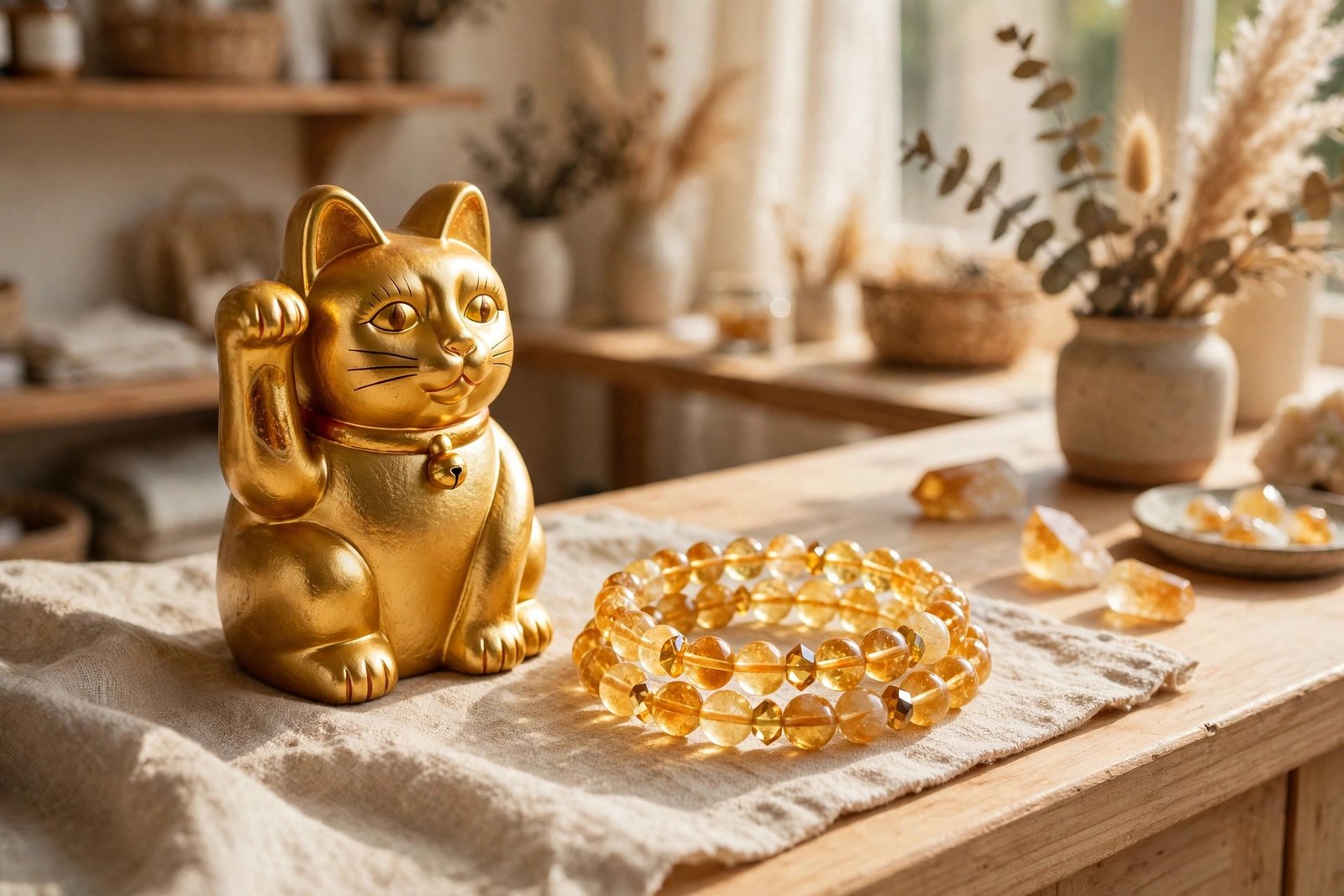
- Gold — wealth and prosperity; the most common choice for shops and cash registers.
- Black — protection; traditionally believed to ward off negativity, similar in spirit to obsidian in crystal tradition (see our obsidian meaning guide).
- Red — health and protection in traditional symbolism.
- Pink — love and romance.
- Green — study, safety, and steady progress.
Color symbolism like this echoes the system behind feng shui jewelry in our feng shui bracelet colors meaning guide. A charming way to carry the theme personally is to match your cat’s color to a crystal: a gold cat beside an AVENSU citrine bracelet, traditionally associated with abundance, or a black cat with an AVENSU obsidian bracelet for a protection-themed desk.
Where to Place a Maneki-Neko
Tradition places the maneki-neko where invitation matters: facing the entrance of a shop, near the register, or by a home’s front door, ideally at a visible height and facing outward toward arriving guests and opportunities. At home, living rooms and entryway consoles are popular; on a work desk, it serves as a cheerful emblem of welcome for clients and collaborators — our feng shui office desk layout for luck has placement ideas that combine well with a lucky cat.
Keep the figure clean and unbroken in tradition — a dusty, chipped cat is said to invite less warmly — and let it be seen rather than hidden in a cupboard. You can find crystals to pair with your cat in the AVENSU shop, and our guide to lucky crystals for business owners rounds out a prosperity-themed workspace.
Frequently Asked Questions
Is the maneki-neko Japanese or Chinese?
It originated in Japan during the Edo period — Gotokuji Temple in Tokyo is its most famous legendary home. It later became popular across China and Southeast Asia, where it is often called the fortune cat or lucky cat, but its roots are Japanese.
Which paw should my lucky cat have?
Choose the right paw for wealth and good fortune, especially for a business till. Choose the left paw for customers, guests, and social warmth — ideal for restaurants and homes. There is no wrong choice; the welcoming gesture is the heart of the symbol.
Why do some lucky cats move their paw?
Motorized and solar-powered versions animate the beckoning gesture, emphasizing the act of invitation. Traditional ceramic figures are static, but the waving versions are widely accepted and especially popular in shop windows.
Can I give a maneki-neko as a gift?
Yes — it is a classic good-luck gift for shop openings, new homes, and new jobs. Gold cats are the standard choice for a new business; white or pink suit housewarmings and weddings. Pair it with a crystal bracelet for a personal, wearable half to the gift.



 English
 Vietnamese